Stage 11: Alfaro – Tudela (24.6 km)

I woke this morning feeling better in my legs but not yet ready to recommence walking the Stages.

The grace we are praying for: Today we are praying for a greater intimacy with and love of Jesus as we contemplate his birth.

Saint Ignatius invites us to: “see the persons, namely, our Lady, Saint Joseph, the maid and the Child Jesus after His birth.  I will make myself a poor little unworthy slave, and as though present, look upon them, contemplate them, and serve them in their needs with all possible homage and reverence.”

I invited the pilgrims to walk with the contemplation of the nativity: to be present as Mary gave birth to her first-born son and wrapped him in swaddling cloths, and laid him in a manger, because there was no room for them in the inn.

Our special intention today is that people will respect and preserve the environment.

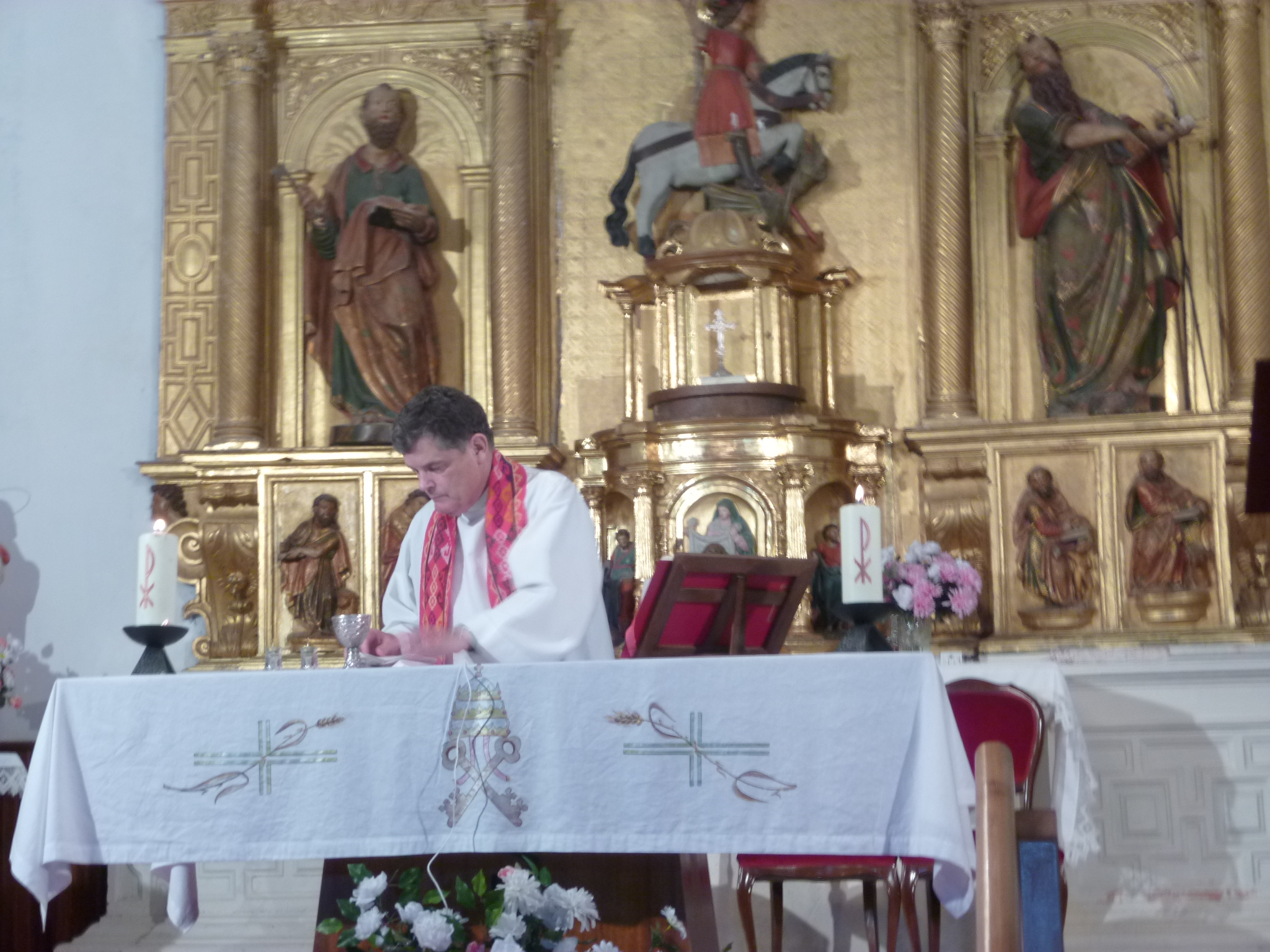
After the rest of the pilgrims had left, I hobbled up to the San Miguel Collegiate Church, and waited until it opened just after 10.00am.  I spent an hour there praying on the nativity scene. I also prayed for the pilgrims on the road.  I prayed at this beautiful side altar which features Our Lady.

The side altar at San Miguel Collegiate Church

The side altar at San Miguel Collegiate Church

After my prayer I looked for a Farmacia in order to purchase a compression sock for my lower right leg.  A man who was playing soccer with his young son in the square in front of the Church showed me the way. I was very touched by his kindness and how welcoming and helpful the people in the Farmacia were.  The compression sock has given me much relief from the pain.

I walked back to the Hotel Palacios in time to catch the bus to Tudela at 11.30am.

Geraldine Naismith wearing the saftey vest

Geraldine Naismith wearing the saftey vest

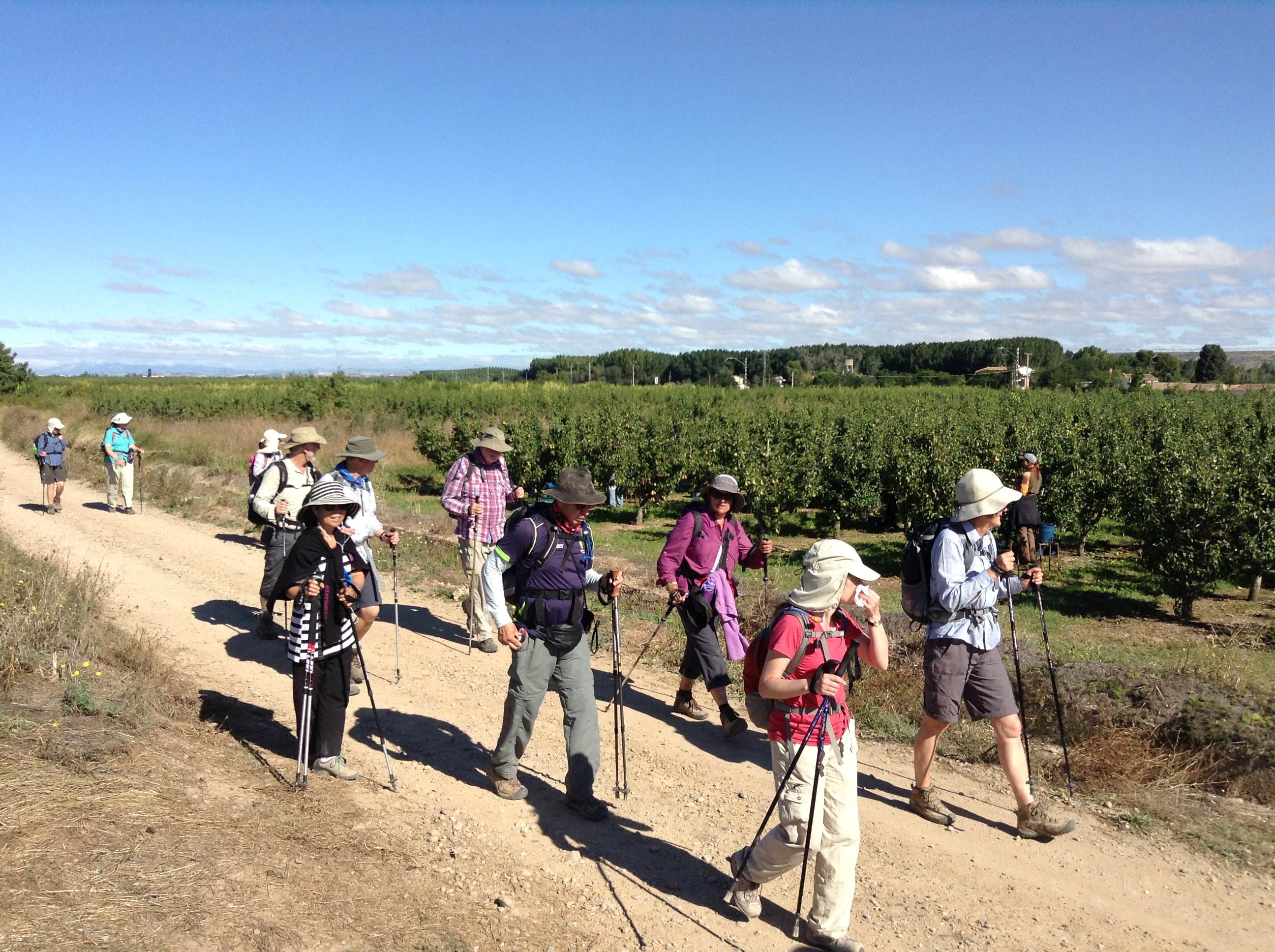
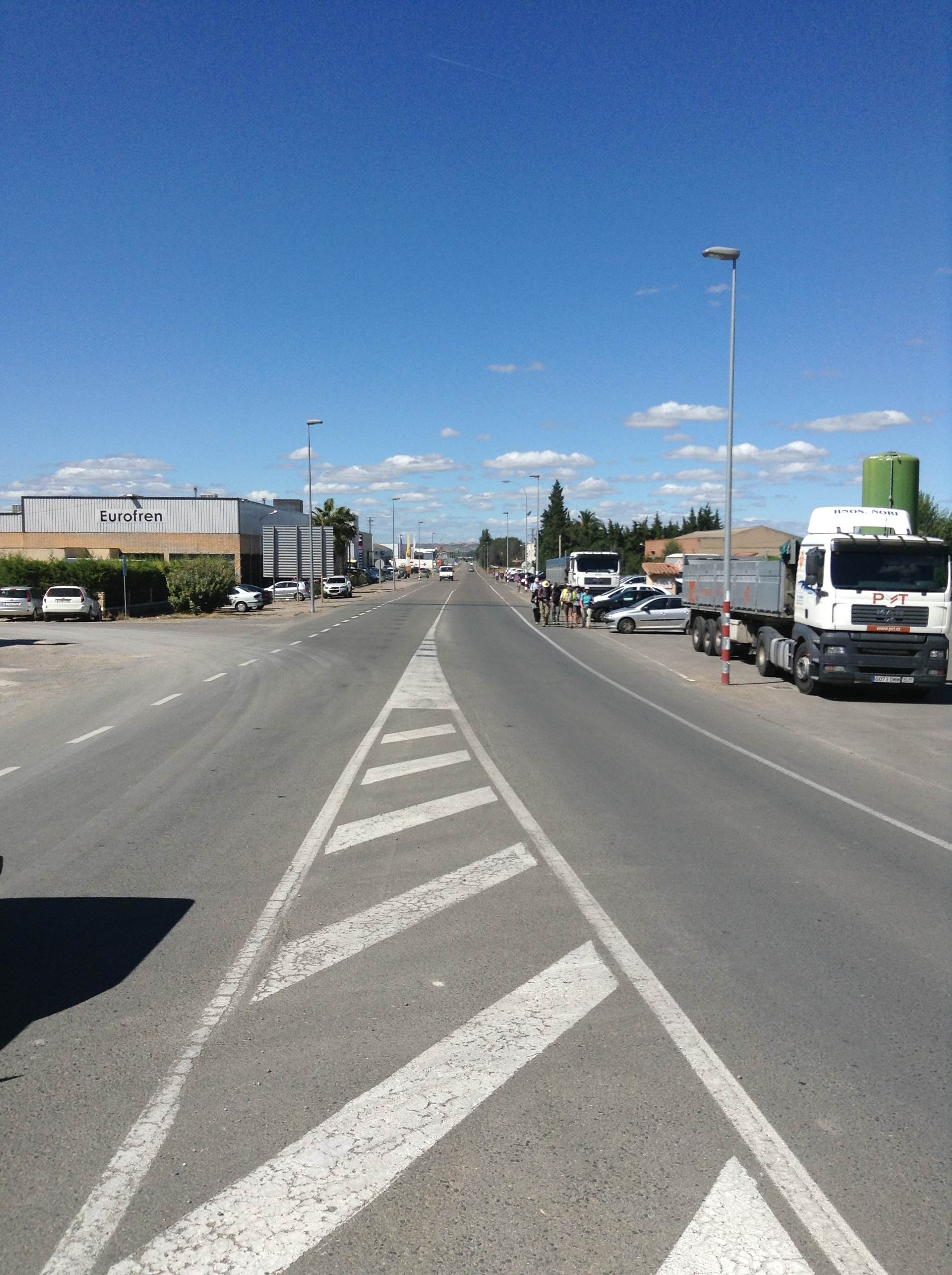
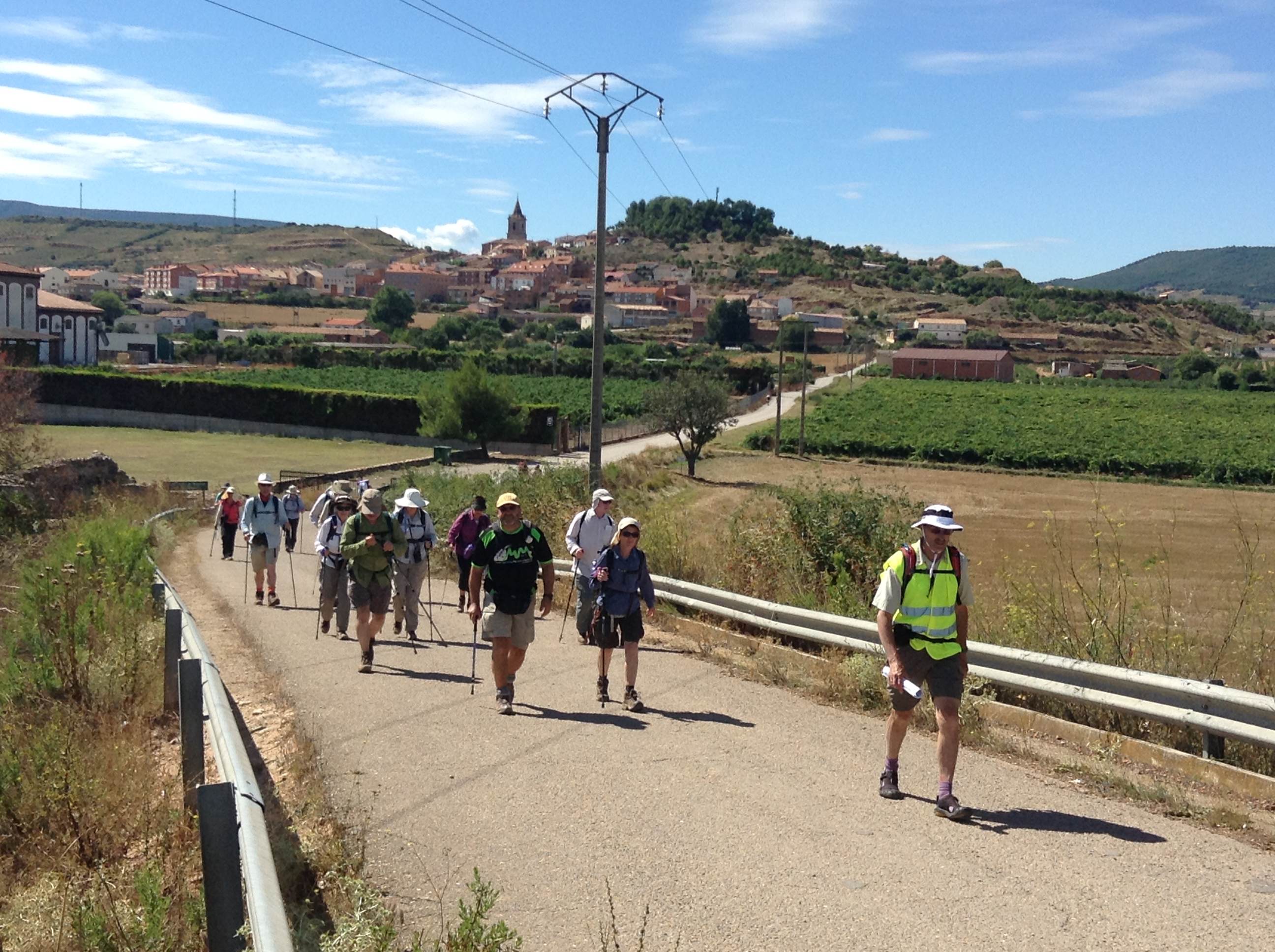
Our system on the open road. As a group we have developed a system when walking on the open road. The two designated navigators for the day walk at the front.  Michael Bertie and Larry Naismith have GPSs, and Peter Walden has the downloaded the maps from Wikiloc onto his iPad which he carries with him.  One of the two wears a bright yellow safety vest.  The person at the back of the group also wears a bright yellow safety vest and makes sure than no one is inadvertently left behind (at a toilet stop for instance), or takes a wrong turn. We walk in single file.  If a vehicle is approaching from behind people call out, “Car back!”  If a vehicle is approaching from ahead people call out, “Car front!” We are very careful to get right off the road when cars drive by.

Today’s walk:  Peter Walden writes about today’s walk and has emailed me these photos:

         “We walked 27 kms despite the documentation saying 24.6 km. Some of this can be attributed to the hotel being  1km from the finish of this Stage of the Camino. We arrived safely as one group and we were blessed with slightly cooler weather despite the forecast saying it would be hotter than yesterday. 
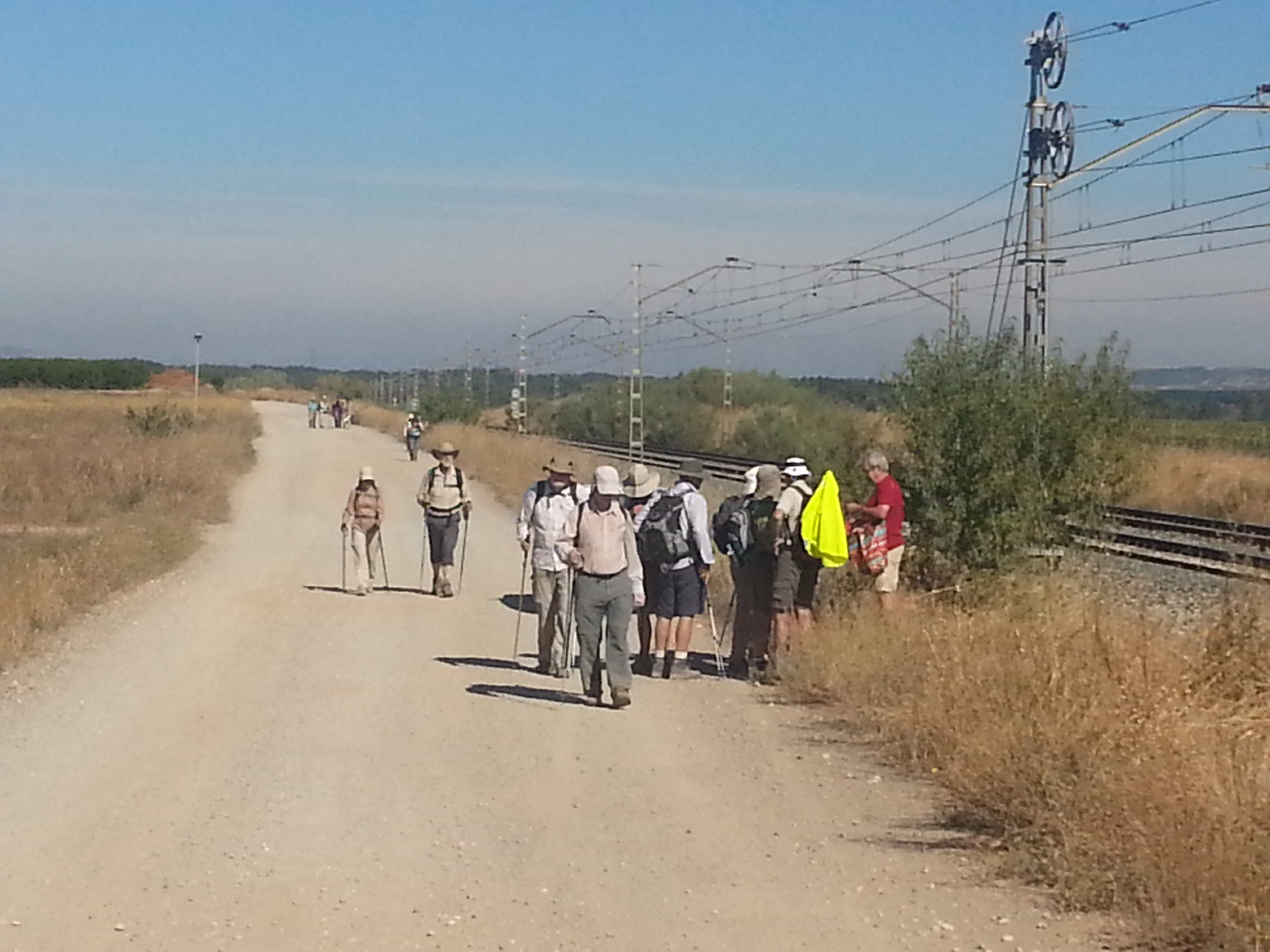
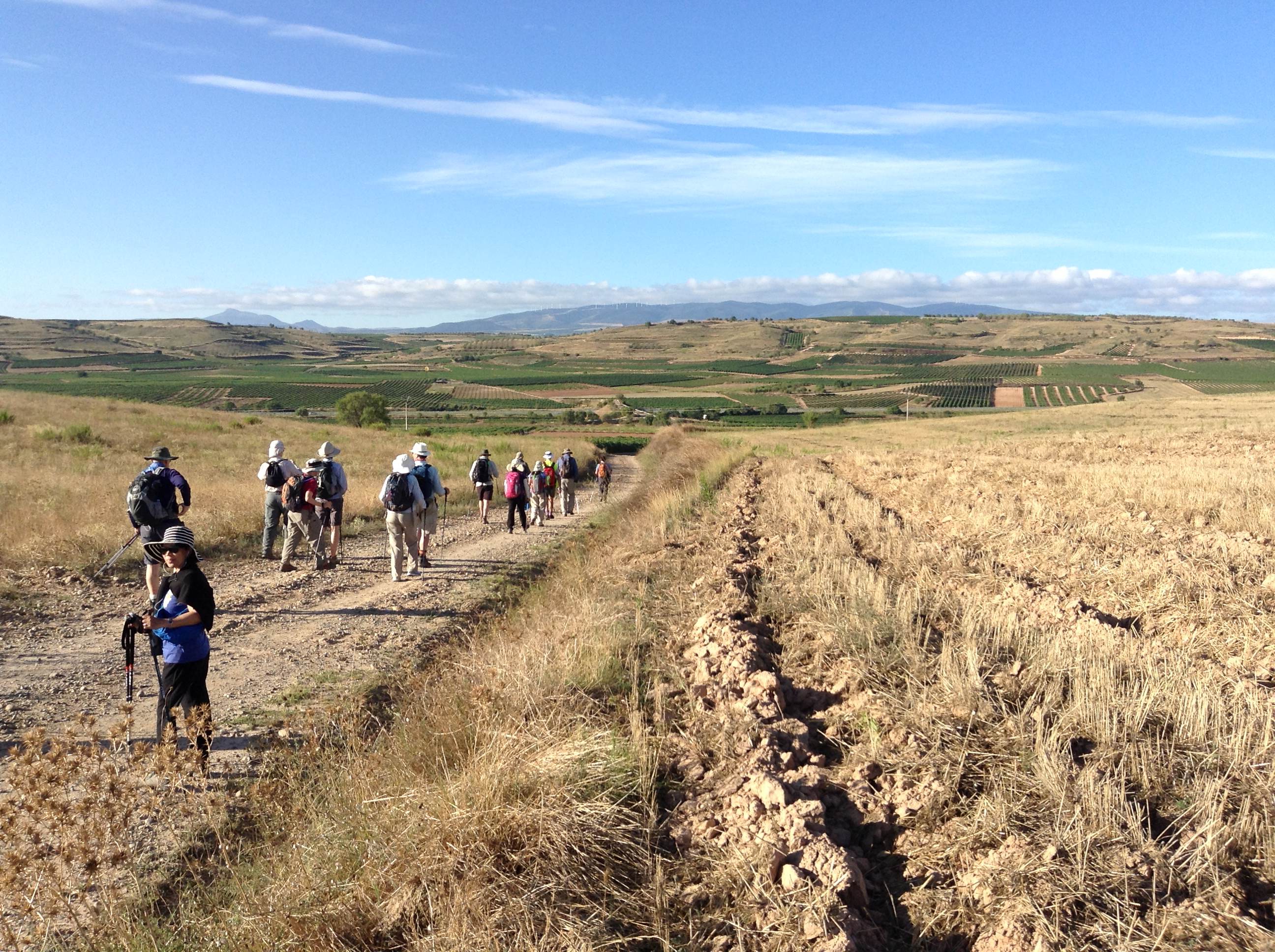
There was very little shade today

There was very little shade today

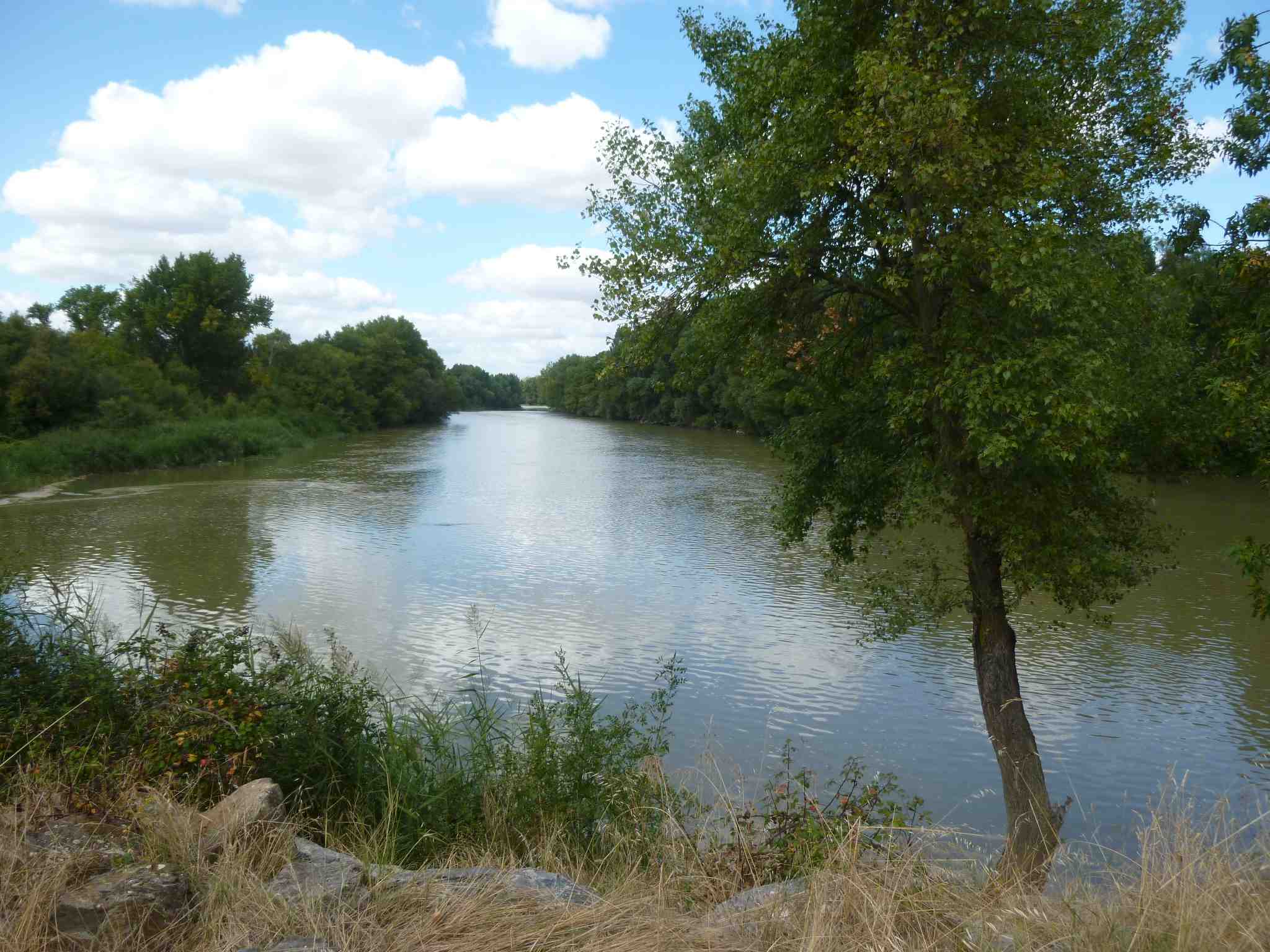
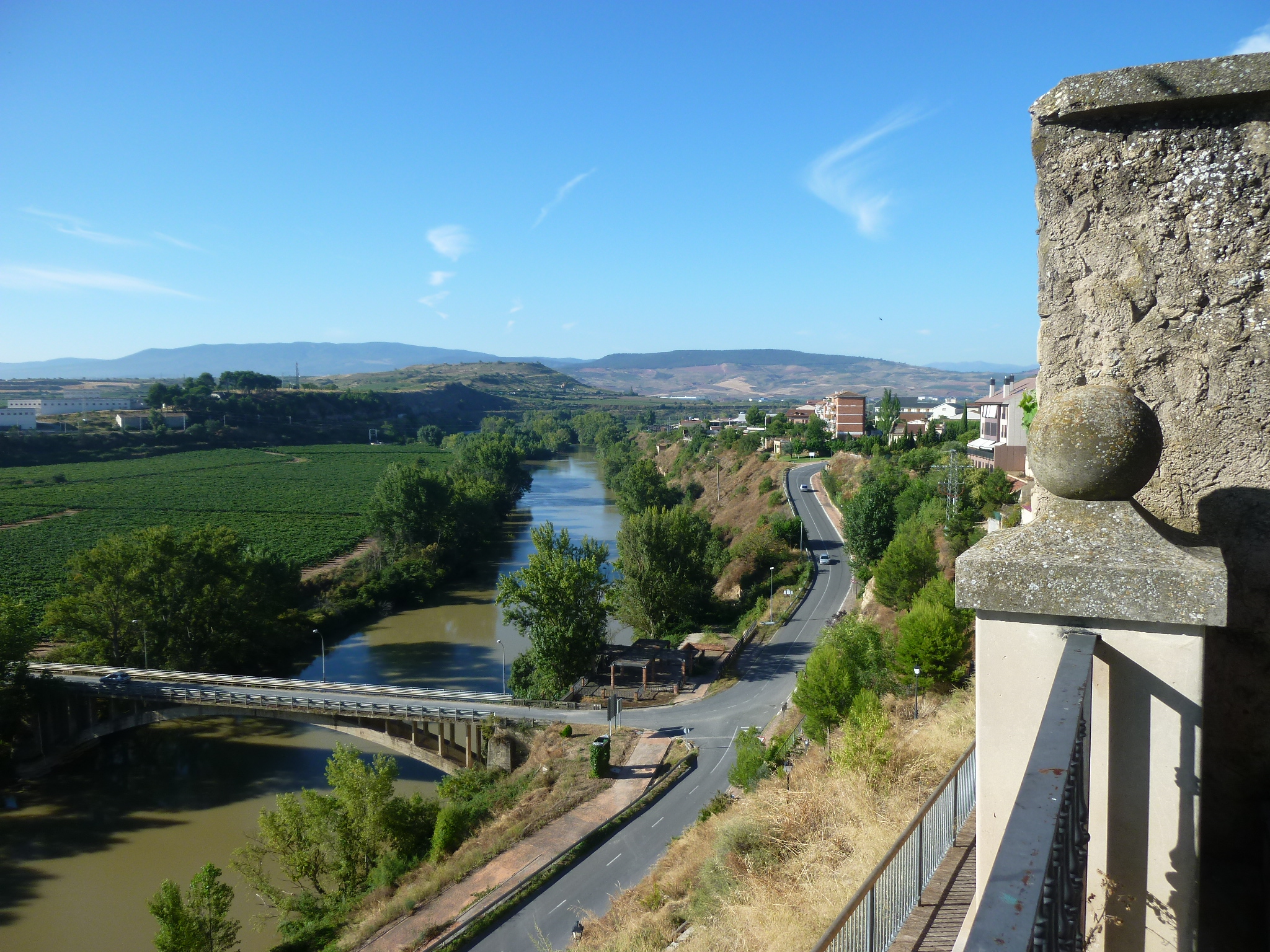
For most of the day we followed the Ebro River and we were rewarded with excellent views of the river. 

Today we followed the Ebro Rover

Today we followed the Ebro River

A bridge over the Ebro River

A bridge over the Ebro River

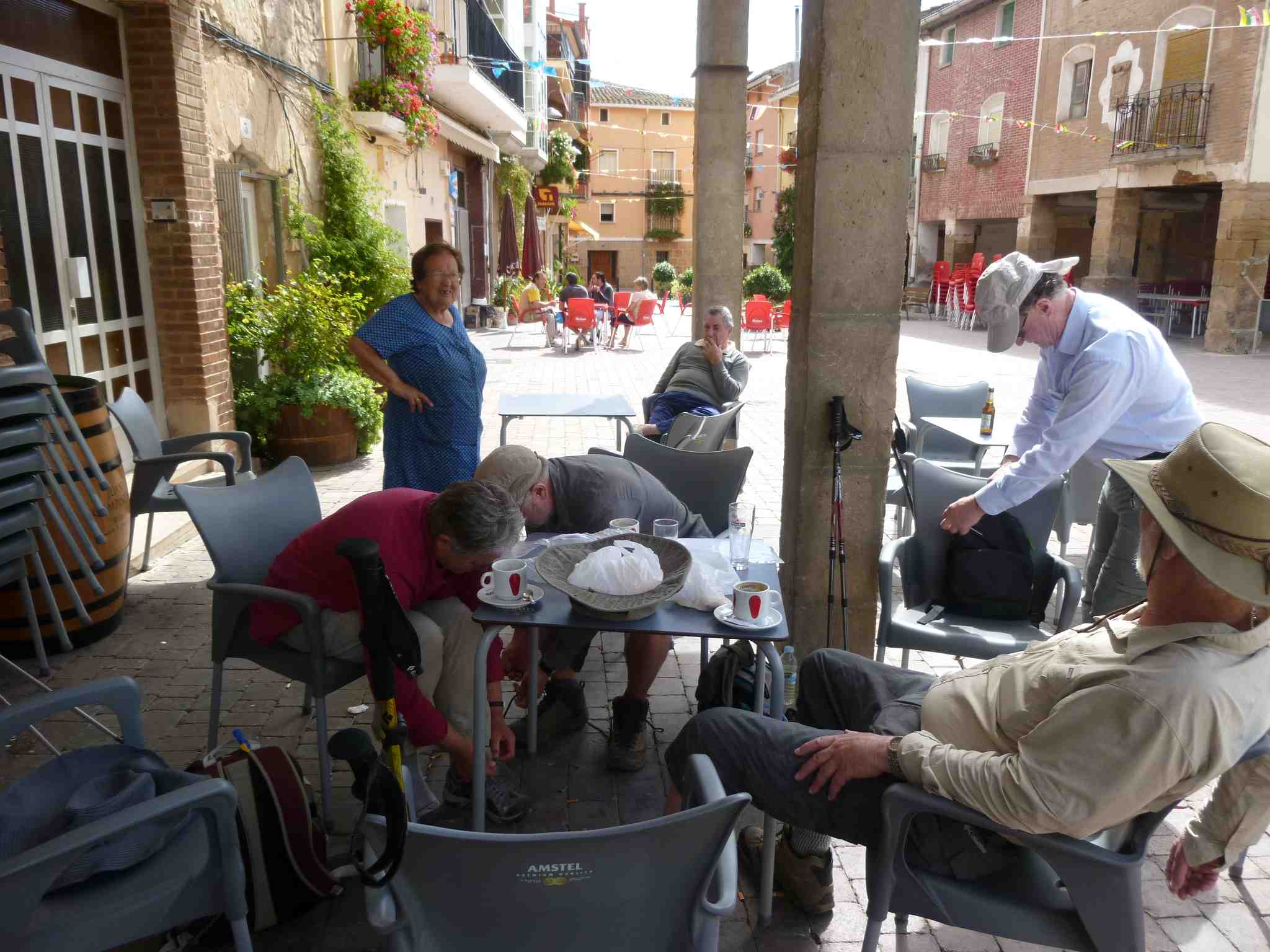
We were struggling to find a suitable lunch site as shade was at a premium again today.  Then before us was a run down house and shading it was a lovely Aussie gumtree, and it even had a tree house. 
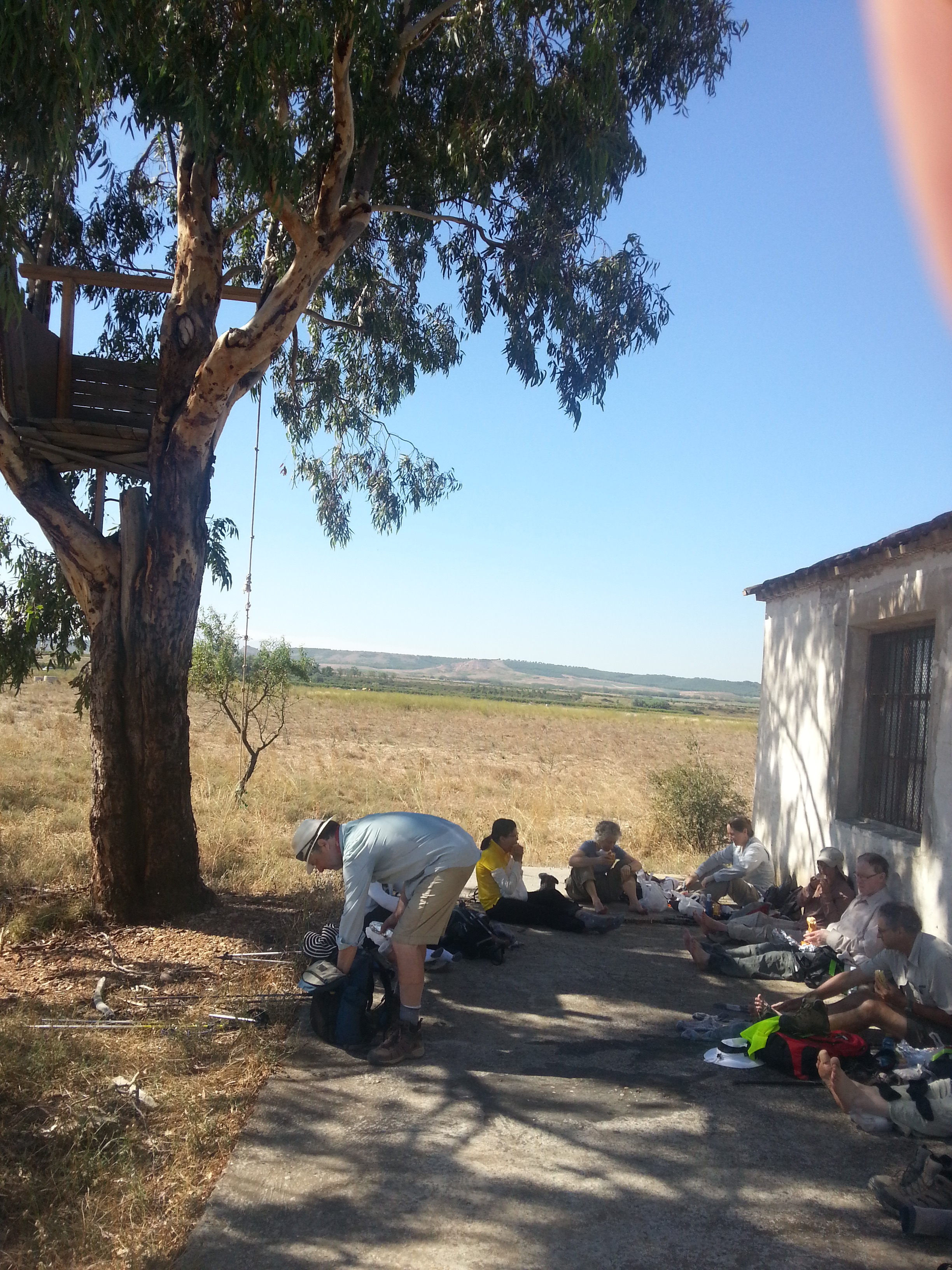
Lunch under an Australian gum tree

Lunch under an Australian gum tree

Farming and harvesting was again the theme for today.  Peaches, tomatoes and apples. It was pointed out to us today that the Spanish farmers do not build their houses on their land, but instead live in nearby villages and towns,  and even park their tractors under the house or at the back or their houses. The group covered 27 kms today and they were thankful to reach the hotel in Tudela at 3:45pm.”

About Tudela.  Founded in 802, Tudela is one of the most important cities of Muslim origin in Spain and Europe. For more than 400 years, Muslims, Jews and Mozarabs coexisted, making the city a cultural melting-pot which is reflected in its historic buildings, winding streets, alleyways, walls and watchtowers.

The architectural gem of the city is the 12th century Cathedral of Santa Maria, built over the remains of an old mosque. It features a beautiful doorway, Romanesque cloister, and light-filled Gothic central nave.
Stage 10: Calahorra – Alfaro (23.7 km)


I woke feeling so much better this morning.  The swelling in my right leg has gone down considerably but it is still quite sore to walk on, so I am going to have another quiet day and I will try to begin walking tomorrow.  Having this condition is quite humbling. When we had the preparatory meetings at Campion before the Camino, I said to the group that there would be the possibility of someone taking the bus if he or she was not feeling well — not thinking for a minute that that person would be me!  Dealing with disappointments and aches and pains is all part of the Camino.


We gathered outside the Hotel Cuidad de Calahorra.  I introduced the Ignatian Exercise for the day beginning with the Preparatory Prayer that everything in our day — all our thoughts, words, actions, eating  a peach, changing our socks, conversations along the road, our desires, our memories and so on — would be directed purely to the praise and service of God.

The grace we are praying for.  Today we are praying for intimacy with Jesus, so that we might follow him more closely. I talked about intimacy in relationships, and that when power meets power in an interpersonal relationship, the result is conflict.  And that when vulnerability meets power, the result is alienation and fear.  But when vulnerability meets vulnerability the result is intimacy and love.  So, to grow in intimacy with Jesus all we need to do is to let down our guard and disclose to him what we are feeling and how we really are.

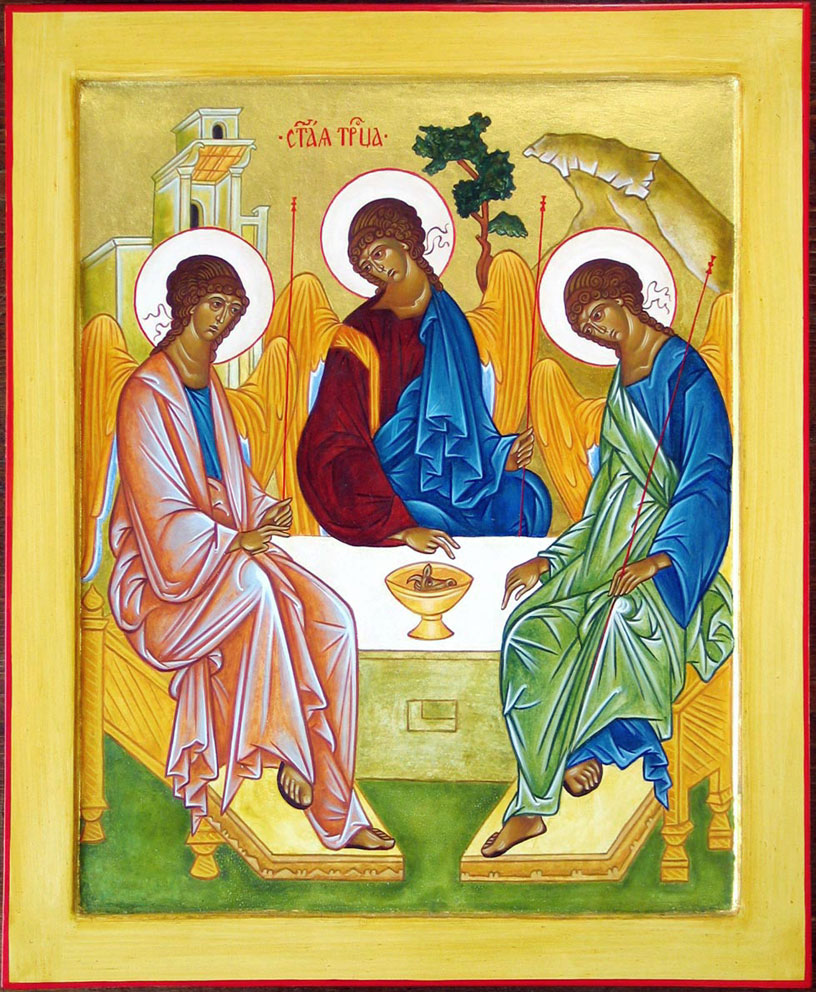
The Trinity (Rublev's Icon)

The Trinity (Rublev’s Icon)

Today we are reflecting on Jesus’s mission of bringing salvation to humankind. Saint Ignatius has us take the perspective of the Trinity looking down on the earth:

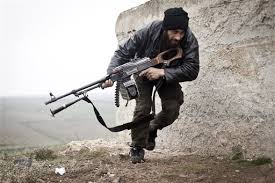
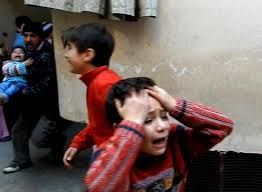
I try to enter into the vision of the Triune God looking upon our world: men and women aimless, despairing, hateful and killing, men and women sick and dying, the old and the young, the rich and the poor, the happy and the sad, some being born and some being laid to rest.  

And this is what our world looks like today:

Victims of the Civil War in Syria

Victims of the Civil War in Syria

Fighting in Syria

Fighting in Syria

The victims of war

The victims of war

The leap of divine joy: God knows that the time has come when the mystery of his salvific plan, hidden from the beginning of the world, will become manifest.

And how does the Trinity do this?  In the incarnation. In Luke 1:26-38, God invites Mary, through the Angel Gabriel, to collaborate in the mystery of the Incarnation. Though free to say “no”, Mary chooses to say “yes”. Mary’s “Yes” is the pivotal point of history.  I notice how the Trinity works—simply and quietly.  A world goes on, apparently oblivious of the total revolution which has begun.  I look at Mary’s complete way of responding to her Lord and God:  “Be it done unto me according to your word.”

The Annunciation

The Annunciation

Just as the Trinity works simply and quietly in Mary at the Annunciation, so too the Trinity works in us pilgrims.

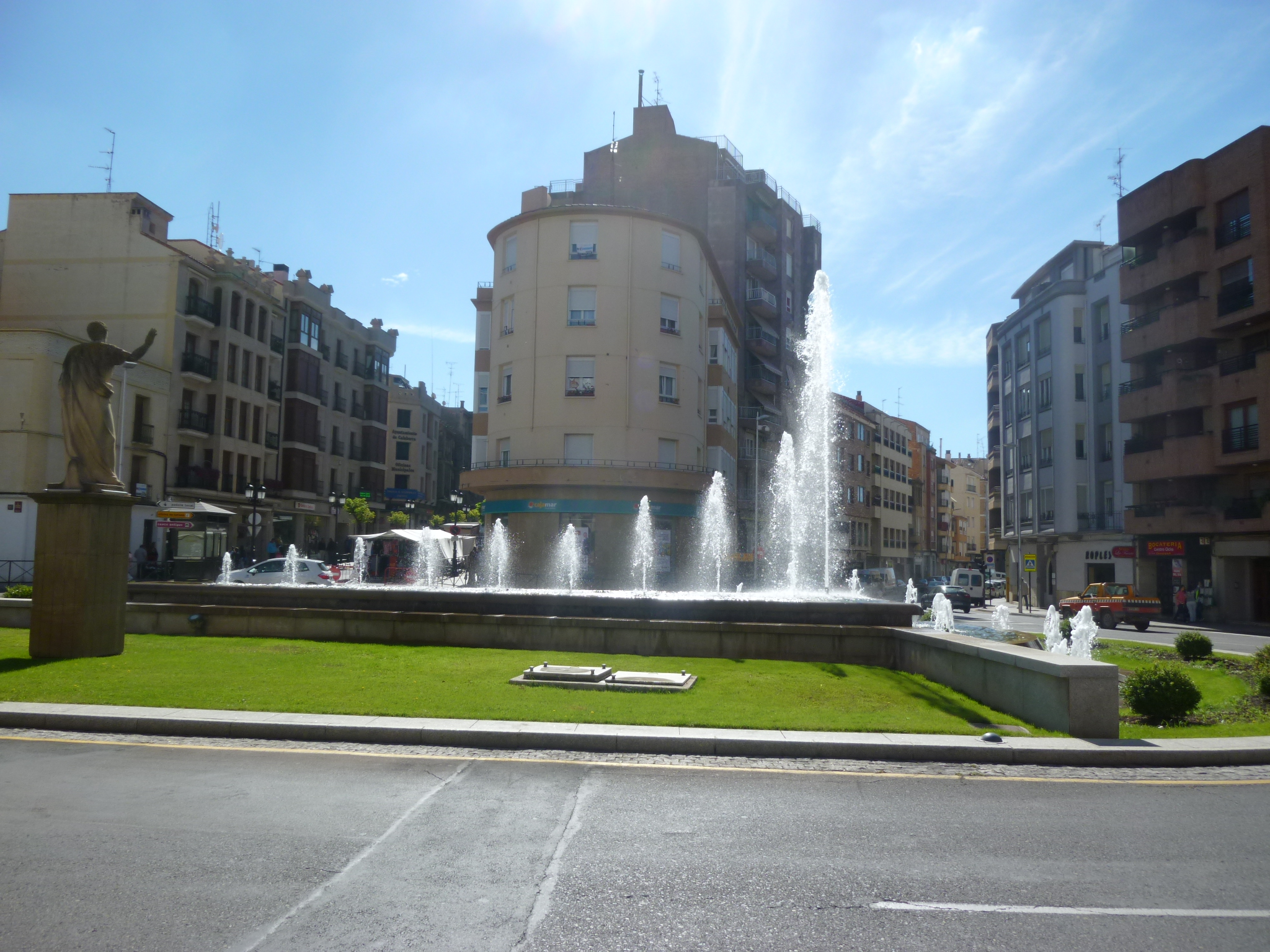
What the day held:  After the bus left Sandra Dillon and I waited for the van which was booked to take the pilgrims’ luggage to the next town, Alfaro.  It came at 11.30am.  We helped the driver to load the suitcases and packs into the back of the van, and then rode with him to the Hotel Palacios in Alfaro. Alfaro is a charming town with picturesque streets and town houses with Aragonese Mudejar influences, made of brick. I hobbled up to the town square with Sandra in front of the the San Miguel Collegiate Church, which is  a 16th century Aragonese Baroque masterpiece, and declared a National Historical Monument. The immense rooftop of the church — which has several slopes, pinnacles and cornices — houses the largest urban colony of storks in Europe.

The pilgrims walked through fields today, and along a section of the Rio Ebro. The Camino traces quiet paved and gravel farm roads. Half-way along the trail, the group passed through the small town of Rincón del Soto. Peter Walden writes:

         “We had a good day today. We walked for 14 kms to the town of Rincón del Soto where we had lunch at the municipal building and stayed for 45 mins. The locals were very friendly and we got lots of waves and smiles. They were very keen to know where we were from. We made good time up to there at 4.3 km per hour as the surface was a lot less rough than yesterday. It is definitely harvest time in the region as there was a lot of tractor traffic on the road. They were harvesting pears and grapes. At one point the pear pickers got very excited upon finding out we were Australian and started tossing ripe pears to some of the group. Many of us got pilgrim stamps there. We followed the railway almost all the way and it was very flat. The challenge today was definitely the heat and the mozzies. It felt like 30°C and we were struggling under the sun as there was virtually no shade on the road. The final stretch was up a very long straight road into Alfaro that seemed to go on forever and the heat off the bitumen was quite intense. Anyway, we thankfully made it to the hotel to rest our weary feet. Total distance walked was 25.2 kms.”
In the Hotel Cuidad de Calahorra before leaving

In the Hotel Cuidad de Calahorra before leaving

The church at Calahorra

The Cathedral of Santa Maria in Calahorra

Looking back at Calahorra

Looking back at Calahorra

Walking through the vineyards

Walking through the vineyards

The long stretch up the hill to Alfaro

The long stretch up the hill to Alfaro

Stage 9: Alcanadre – Calahorra (20.6 km)

I woke up this morning feeling very sore.  It was actually difficult to stand up after getting out of bed. I have set myself to walk the entire Ignatian Camino but I think I could do myself some serious damage if I walk today, so I have decided to take a rest for the day in the hotel.  I currently have an ice pack on my right shin in an attempt to bring down the swelling.

My swollen shin

My swollen shin

After breakfast we gathered outside the hotel where the bus was waiting to transfer the pilgrims back to Alcanadre. Peter Walden again briefed us on the walk helped by Larry Naismith’s advice on the weather and the lack of small towns on the way where pilgrims could find water.  Pilgrims took plenty of water in their daypacks.

Ignatian exercise.  I talked about the Ignatian exercise for the day.  Today we begin the “Second Week” of the Spiritual Exercises. Our point of entry is through a meditation that invites us to follow Christ the King.

The grace we ask for: Despite my limitations, and aware of the love of the Father for me, I ask for the grace to feel personally called to journey with Jesus as his companion and co-laborer.

The grace we were praying for yesterday was a deep awareness of God’s merciful love.  When a person experiences being a loved sinner, it often leads him or her to desire to respond to that love. Today we begin to meditate on Jesus’ invitation to walk beside him in his work. In the Spiritual Exercises Ignatius places God’s call to work with Christ just after the meditations that touch on our own human sinfulness. The juxtaposition is important: God calls us to work closely with him in the world as ‘loved sinners’. The gospel for today is Luke 5: 27-32 in which Jesus calls Levi, a Tax Collector and a hated public sinner, to “Follow me”. Even though we may feel unworthy of being called to be companions of Jesus, he calls us nonetheless.

Vin Dillon also suggested that pilgrims spend the the first two hours of silence praying for families.

Fr Joe Taylor and I are both feeling a little “worse for wear” today so we stayed behind. As we waved off the others on the bus back to Alcanadre I felt a twinge of sadness. My goal of walking the entire Ignatian Camino will not be met.

Downtown Cahahorra

Downtown Cahahorra

Modern Calahorra

Modern Calahorra

I took some time in the morning to wander, gently, around Calahorra.  It was a city of great importance in Roman times when it was called “Calagurris”.  There are still Roman ruins to be found in the city. Calahorra has a long pilgrim tradition, as can be seen in the baptismal font of the 16th century Cathedral of Santa María (covered with shells, gourds, and the image of St. James).

I purchased a pair of new boots and visited a Farmacia for some 600 mg Ibuprofen (we can only get 200 mg tablets in Australia) and some gel to rub on.

Peter Walden took some photos if the walk today which are displayed below.

The Hotel Cuidad in Calahorra

The Hotel Cuidad of Calahorra

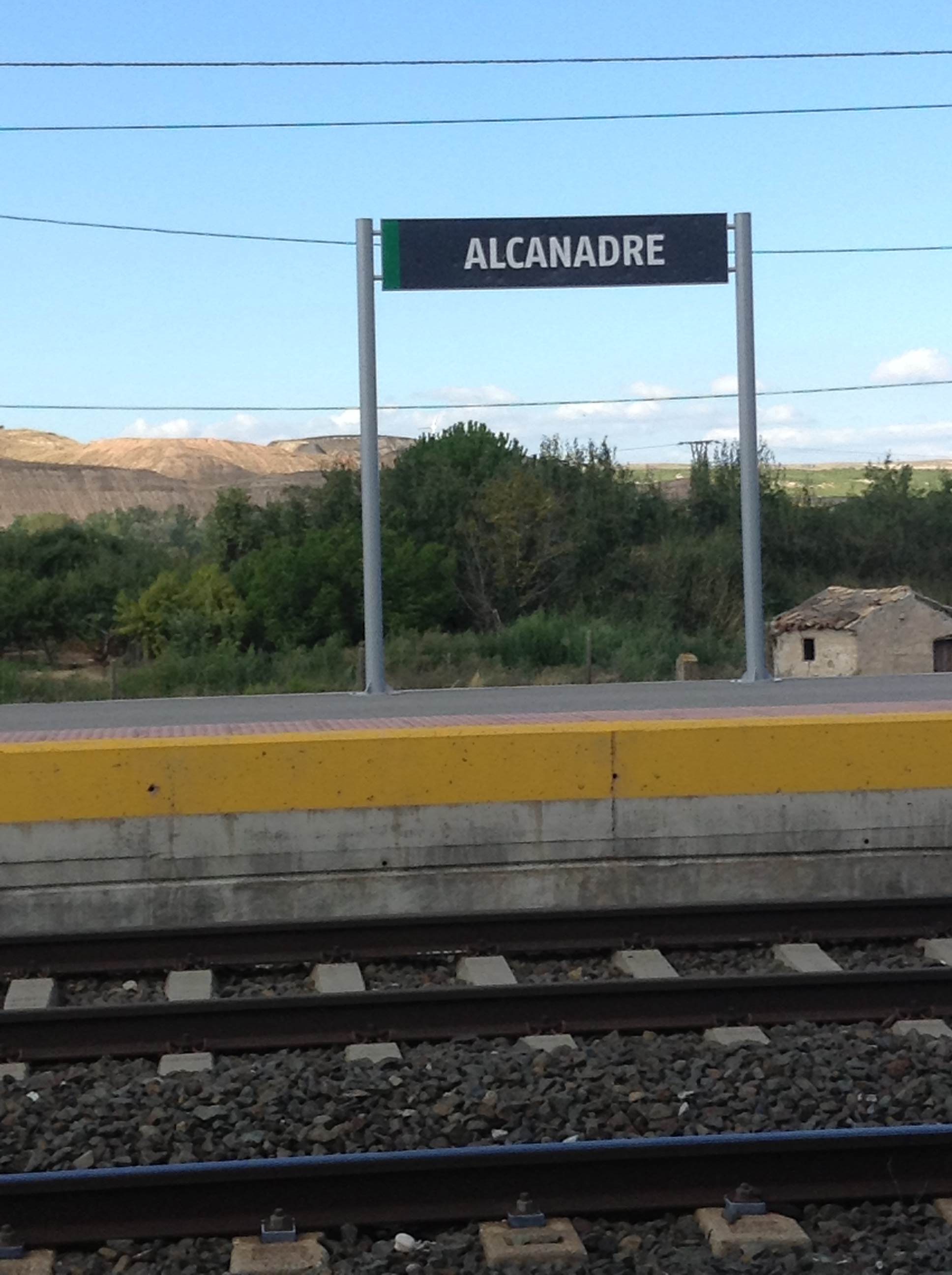
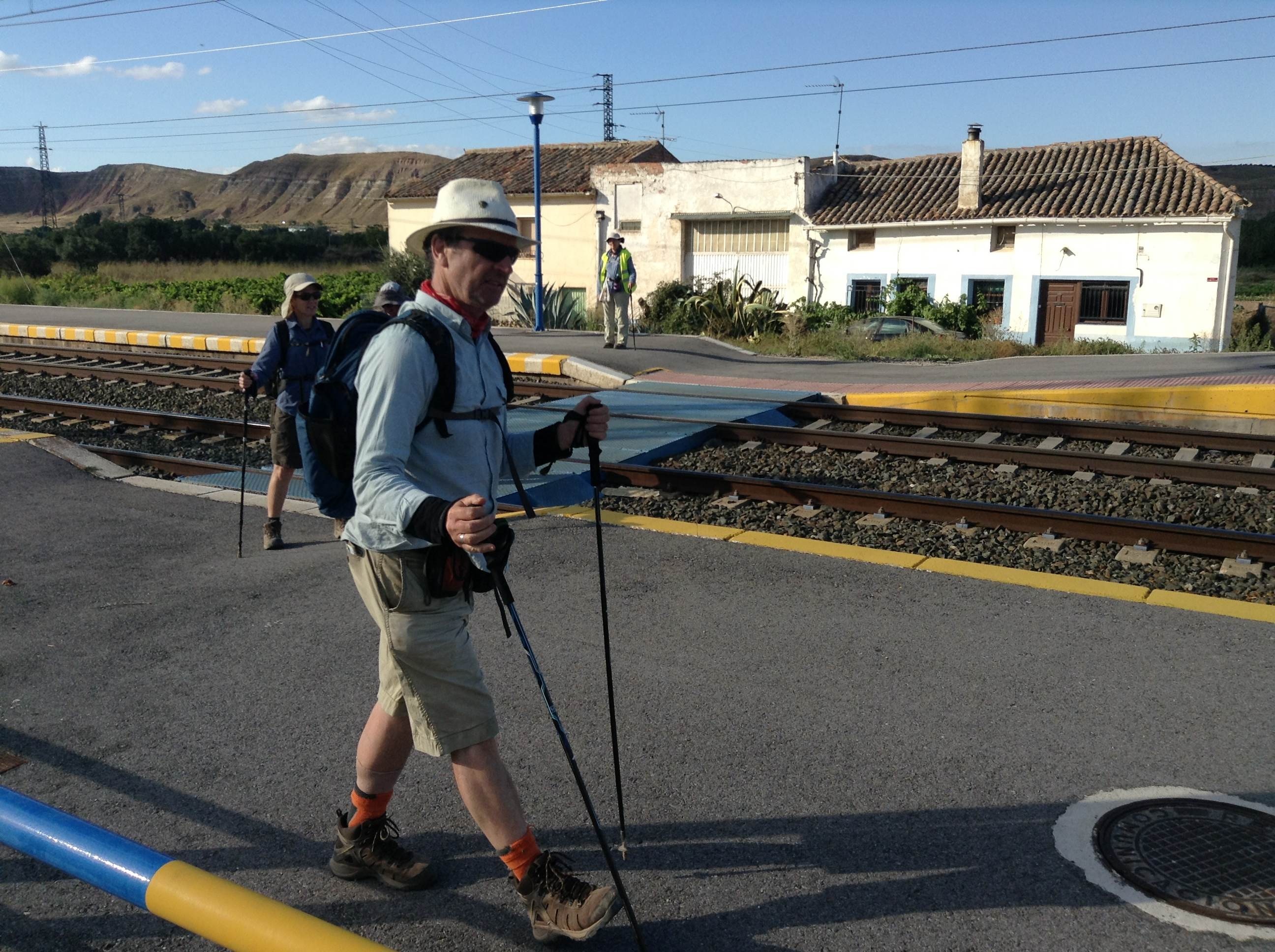
At the Alcanadre Station ready to start

At the Alcanadre Station ready to start


The walk was fairly flat today

The walk was fairly flat today

Enjoying lunch under a tree

Enjoying lunch under a tree


Stage 8: Logroño – Alcanadre (32.4 km)

After a  rest day in Logroño, we embarked upon a long, and as it turned out, difficult stage of the Camino Ignaciano.  We gathered in the park outside the hotel and were briefed by Peter Walden about the walk.  Then I talked about the Ignatian exercise for the day which was on sin and healing. Vin Dillon suggested that we pray for friends and family who are sick and suffering. We each mentioned someone whom we were going to carry in our hearts today.  Then we set off in silence through the streets of Logrono filled with people getting to work or dropping their children at the school gate.

A big job:  how to stop the bell tower from falling over?

A big job: how to stop the bell tower from falling over?

En route to Alcanadre we passed through several small towns and villages located on – or close to – the mighty Ebro River, and walked through vineyards and olive groves.

Sandra, Daddy, Patrick and Joe getting ready to start again after lunch

Sandra, Daddy, Patrick and Joe getting ready to start again after a break for lunch

On the road from Logrono to Alcanadre

On the road from Logrono to Alcanadre

Stork nests feature on the bell towers of many churches

Stork nests feature on the bell towers of many village churches

We passed trough many vineyards today

We passed through many vineyards today

Not long after leaving the hotel in Logrono I developed shin splints in my right leg.  As the day wore on they started in the left leg too.  It was very painful to walk.  I thought about taking a bus or a taxi or a train to Calahorra, but none was available, so I had to keep on walking.  We left Logrono at 8.20am and it was 6.10pm when we arrived in Alcanadre.  We were on the road for almost 10 hours.  It was a very long day made possible with Voltaren cream, Ibuprofen, Panadol and very supportive fellow pilgrims.

The Ebro River

The Ebro River

The Alcanadre railway station where we met the bus

The Alcanadre railway station where we met the bus

The name of Alcanadre is Arabic in origin: Al-Cana-Dre, referring to the “bridges” or “arches” of an old bridge over the Ebro River, whose ruins are near the town.  The 16th century church of Santa María preserves a lovely Romanesque image, while the remains of a 1st century Roman aqueduct can also be seen.

Fr Stephen Delbridge still going strong after 32.4 kilometres

Fr Stephen Delbridge still going strong after 32.4 kms

After we arrived in Alcanadre, a coach  transferred us to our lodgings in Calahorra.

In the evening we had Mass at the hotel celebrated by Fr Paddy Mugavin which we integrated with our sharing of the joys and struggles of the day. Dinner was at 9.00pm, so it was a late night after an exhausting day.

Rest Day (Logroño)

Today we enjoyed a rest day in Logroño, the capital city of the autonomous region of La Rioja.  Fermin took us to visit the 16th century Cathedral of “La Redonda” with its two Baroque towers called “Las Gemelas” (the twins).

The rest day in Logroño gave us the opportunity to wash our clothes, rest, recuperate, stock up on supplies, make use of facilities such as the post office, and to visit the old city.

We are staying in the Hotel Cuidad de Logroño in downtown Logroño, and across from the González Gallarza Park.

Stage 7: Laguardia – Navarrete – Logroño (30.3 km)

We got a huge surprise when we walked out the gate of the Hotel Villa  Laguardia. There was our Basque guide Fermin Lopetegui waiting for us. He had decided to walk Stage 7 of the Ignatian Camino with us and had driven over from his home in Zumarraga. We were very pleased to see our friend.

We farewelled Laguardia and embarked upon our longest walking day yet. Thankfully the terrain was gently rolling. The weather was quite cold and misty when we left just after 8.00am. We passed through vineyards and fertile farmlands.

We again prayed in silence for the first two hours of our walk. Fr Paddy Mugavin suggested that we pray for healing of the pain and hurt that has happened as a result of sexual abuse in the Church. First the healing of the hurt of victims and their families. We prayed for the grace to be able to listen to their stories and learn from what they can teach us. We prayed also for the others levels of woundedness in our church, and our church communities. We prayed that we as a Church might learn what needs to change in church culture so that such abuse will never happen again.

We crossed the Ebro River — Spain’s largest river, and left the Basque Country en route to Navarrete.

The bridge across the Erbo River

The bridge across the Ebro River

Strategically built on a hill, the houses with their coats of arms show the importance of Navarrete. In 1482 the Catholic Monarchs granted the noble title of Duke of Najera to the father of Duke Antonio Manrique de Lara (also viceroy of Navarre from 1515 to 1535), who knew Ignatius of Loyola very well. It is known that Ignatius came to the Duke’s palace in Navarrete to settle an outstanding account with him when he was on his way to Montserrat.

As we entered Navarrete we saw other pilgrims, all clad with backpacks, walking sticks, and the scallop shell symbol. These pilgrims were walking in the opposite direction to us and are on the “Camino Frances” (the French Camino) to Santiago de Compostela. I walked the same pilgrimage in May-June 2011. It is interesting to revisit some of the places I passed through just over two years ago. Some of the pilgrims on the Camino Frances indicated that we were gong the wrong way and we had to explain that we were on a different pilgrimage — the Ignatian Camino to Manresa. I don’t think they quite understood. The Igntian Camino is not well known.

Church of the Assumption (Asunción de María) in Navarrete

Church of the Asunción de María in Navarrete

After a Jamón y queso (ham and cheese) sandwich and a drink at Navarrete we continued on to Logroño.

Leaving Navarrete for Logroño in the hot afternoon sun

Leaving Navarrete for Logroño in the hot afternoon sun

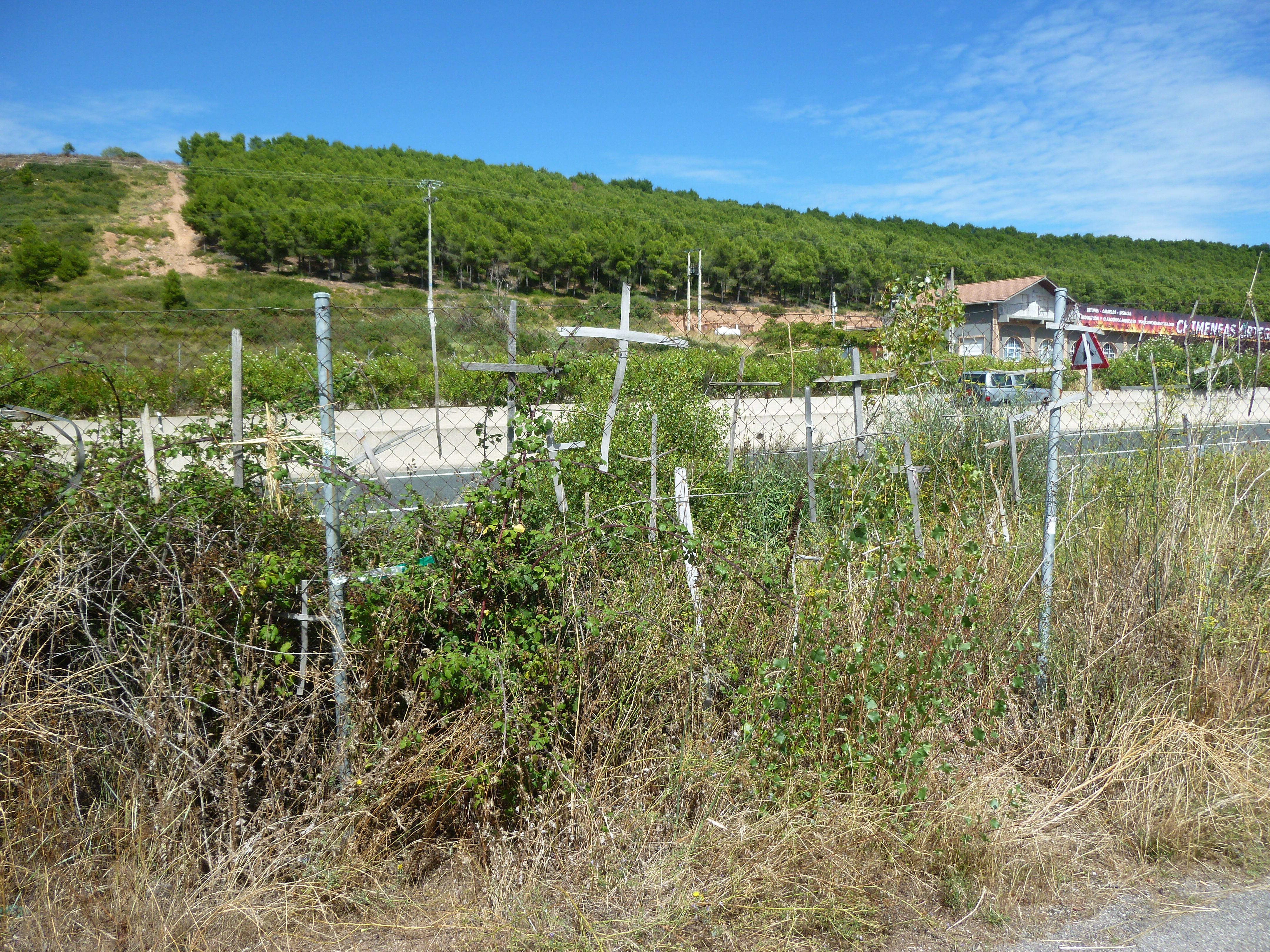
On the way to Logroño we passed the fence where  pilgrims on the Camino Frances make small crosses and weave them into the fence.  I remembered doing this in 2011.

Crosses on the fence

Crosses on the fence

It was a long walk and my feet are very sore this evening although the rest of my body is holding up quite well. We have walked about 60 kilometres in two days. Tomorrow we will have a rest day and we are all looking forward to the opportunity to recuperate and do some washing.

Stage 6: Genevilla to Laguardia (27.5km)

The bus picked us up from the Hotel Villa de Laguardia and took us back to Genevilla to commence our next stage of the Camino Ignaciano — walking back to Laguardia.

We again prayed in silence for the first two hours of our walk from Genevilla to Laguardia. Vin Dillon suggested that we pray for our newly elected government in Australia following yesterday’s Federal Election. He suggested that we pray that the new term of the Parliament would be a contest of ideas rather an a contest of personalities. We also prayed that the policies and the allocation of resources would take into account the needs of all Australians especially the weak and vulnerable. A special mention was made of the plight of asylum-seekers. Given that both the Labor Party and the Liberals seemed to be in a competition to see which party could be most punitive to refugees, we prayed for a change of heart in both our politicians and the general public.

Today, following the pattern of the Spiritual Exercises, we begin to consider sin in our lives. We were asking God to reveal our sin because, when God reveals our sin God also reveals His love for us. It is very freeing to become aware of our sinful tendencies, those aspects of ourselves which draw us away from God because then we can turn to God to ask for forgiveness and healing. Today was overcast and the weather matched the matter for prayer.

The route was long but the only difficult section was the first two hours up into the mountains. The rest of the day was a descent into Laguardia through the vineyards and farmlands of La Rioja.


Coming up the mountain

Coming up the mountain

At one point during our walk we passed the 100 Kilometre mark. Just 540 kilometres to go!

The 100 Kilometre mark

The 100 Kilometre mark

Laguardia is a charming and historic walled town built upon an intricate system of underground “caves” or cellars, excavated under the houses and streets. We enjoyed an early evening walk through the narrow cobbled streets, to the lovely Romanesque 12th century Church of Santa María de los Reyes where Fr Joe Taylor said Mass for us.

Stage 5: Alda – Genevilla (17.9 km)

The Holy Father had asked that today, Saturday 7th September, be a day of prayer and fasting for peace in Syria, which is now under threat of attack by the United States and France. At one point in the Gospel, when the disciples of Jesus could not free a young man from an evil spirit, Jesus told them: “This kind of spirit can only be driven away only by prayer and fasting”.  The Pope is asking us to pray and fast that the threatened attack on Syria does not take place. We discussed over dinner last night how we could best respond.  I said I didn’t think it would be a good thing for us to fast while we are walking as we need to eat given our physical exertion. So we decided to spend the first two hours of our walk today in silence praying for peace. It was a powerful experience to be walking in silent prayer. We have decided to begin each day in this way.

From Alda we descended to San Vicente de Arana, where the trail runs parallel to the quiet paved road to the village of Santa Cruz.

Dani Chamberlin and Amanda Hickey having a break

Dani Chamberlin and Amanda Hickey having a break

Today was an easy walk compared with the last three days in the mountains.  We had lunch at Santa Cruz the walked on to Genevilla along a well-marked dirt road. The bus picked us up to transfer us from Genevilla to our hotel in Laguardia.  But it broke down on the way.  While we waited for a replacement vehicle to arrive we had our reflection on the day.

The region where we are staying is called La Rioja Alavesa where the “Rioja” wines come from. Our Hotel Villa de Laguardia (Laguardia) looks out over the vineyards in Laguardia. 


Stage 4: Araia – Alda (21.5 km)

This morning we said goodbye to the tranquil Franciscan sanctuary of Arantzazu.  We also said goodbye to the travel agent, Luis Renes, who walked with us for the first three days.  He told us that he would like to continue to walk with us, but his Australian-born wife has recently given birth to their second child and he needs to be at home to support her.  His organization of the pilgrimage has been impeccable and we will miss him.  Still we can contact him by phone if we need to.

We took the bus back to Araia where we commenced our day’s walk at 11.00am.  Today was a third mountain climb in a row.  It was not as difficult as Stage 2, but it was physically demanding nonetheless.  From the top of Mount Entzia we enjoyed spectacular views.

Then we descended into the picturesque Arana valley which is very rich farm land. We arrived at Alda a traditional Basque village at 6.10pm.  We are staying at Casa Rural Biltegi a family-run guesthouse in the mountain village of Alda. Our Basque guide Fermin left us at Alda to take the bus back to Araia.  Although Fermin did not speak a word of English and none of us could speak the Basque language, we managed to communicate with him and very much appreciated his guiding us through the mountains which are not well-marked.  We thanked him, sang the Pilgrim Song for him and gave him a small gift.  He was very touched and wept.

The owner of Casa Rural Biltegi had organized Mass for the group at 6.30pm, so we walked over to the church in our hiking gear.  The priest was waiting for us.  He unlocked the church and set up the altar for Mass.  He told me that was responsible for nine parishes in the region.  I put on the vestments over my sweaty shorts and tee-shirt and said Mass for the group.  I was so stiff after the day’s walk that I found it hard to climb up the stairs to the sanctuary.

Mass at Alda

Mass at Alda


At 8.00pm we had a lovely meal including fresh salad.

Stage 3: Arantzazu – Araia (17.7 km)

It is amazing how a good night of sleep can repair the body.  After eight hours of rest I felt ready for another day of walking.  After breakfast we were ready to go.

We warmed up our legs with a climb out of Arantzazu to a mountain pass at 1180 m.  We walked though the lush Aizkorri-Aratz National Park, home to the highest peaks of the watershed between Cantabria and the Mediterranean. on the way up. On the way up the mountain a local man showed us a fossilized scallop shell in the rock formation.  At some stage, millions of years ago, this part of the mountain was under the sea. I reflected that God has been at work in the world for millions of years.

Fossilised scallop shell

Fossilised scallop shell

Part of the trail today joined up with the Camino de Santiago Vasco (the Basque Way to Santiago). After connecting with the Camino de Santiago, we continued to the small village of Araia.

Sacha Bermudez-Goldman left us this evening to travel back to Madrid where he is writing his thesis for the Licentiate.  It has been good to walk with him over the three days.

The bus met us at Araia and took us back to the hotel at Arantzazu where we spent our second night.

We have set up a leadership group of Larry Naismith, Michael Bertie, Peter Walden, Helen Lucas and me which met this evening.  We realise that once Luis Renes and Fermin leave us we will have to do our own navigation.  Larry, Peter and Michael all have GPS devices and have studied maps.  One of the things I am most concerned about on the Ignatian Camino is getting lost as the way is not well marked.