On Saturday 16 November, six weeks after we returned from the Ignatian Camino, some of the pilgrims gathered in Melbourne for a barbecue in the Jesuit community at Xavier College. It was a joyful reunion. Stephen Delbridge told us at the barbecue that he had started a blog on his experience of the Ignatian Camino. You can read Stephen’s blog by clicking the link here.
Libby and Stephen Delbridge, Frank and Dani Chamberlin
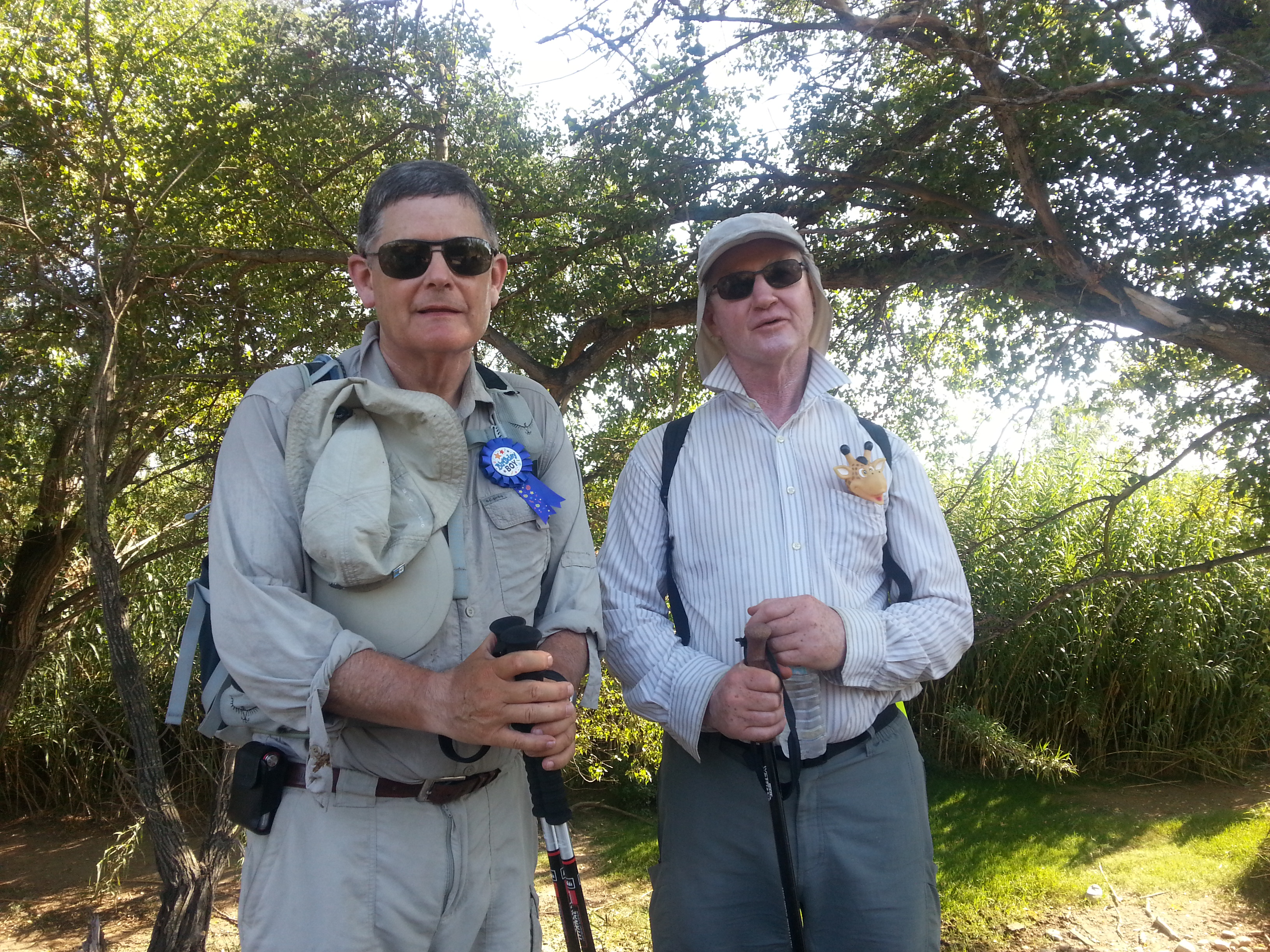
Patrick Hynes, Dani Chamberlin, Stephen Delbridge and Michael Bertie
I took the opportunity to interview some of the pilgrims during the afternoon. Here are their reflections on the experience of walking the Ignatian Camino.
Fr John Fitzgerald, the Parish Priest of St Joseph’s Church, Warnambool in the Diocese of Ballarat, Victoria, was one of four Catholic priests who walked the Ignatian Camino in September. Shortly after his return to Australia, he was interviewed on ABC Radio on 15 October. You can listen to his interview by clicking here. You can also view some of his photos on the ABC website.
Fr John Fitzgerald standing by a cross in the church at Tarrega which has various symbols of the crucifixion
After breakfast the group took a bus across the city to visit Antoni Gaudi’s Sagrada Familia Basilica. The amazing façade of the building houses a modern interior full of light.
Antoni Gaudí was bornon 25 June 1852 and died on 10 June 1926. Gaudí’s work reflects his passions in life: architecture, nature, and religion. Gaudí integrated ceramics, stained glass, wrought iron into his buildings. We are so pleased that we visited it. It was a fitting conclusion to our Ignatian Camino.
At 1.00pm a bus took us to Barcelona airport for our onward flight to Australia. We are nearly at the end of our amazing journey.
Tired but happy pilgrims at Barcelona Airport
We have become a pilgrim community, and experience has been transformative in many ways. If you have the opportunity to make the Camino Ignaciano, I hope you take it.
In the morning we met as a group at 8.30am to evaluate the Ignatian Camino. Vin Dillon was our facilitator and helped us with a good process. After breakfast we had a talk from Josep Sugranyes SJ. We spent the rest of the morning exploring the Centre of Ignatian Spirituality.
Our credentials received the stamp for the final stage, and Helen picked up an “Ignaciano” for each of us, our official certificate of completion. We also purchased tee-shirts, calendars and other memorabilia. After spending the morning in Manresa, we took a bus to Barcelona.
In the late afternoon Josep Lluís Iriberri SJ. met us at the hotel in Barcelona and took us on a tour of the Ignatian sites in the city. Then he joined us for dinner and a review of the Ignatian Camino.
Josep Lluís Iriberri, SJ planning our afternoon walk around the Ignatian sites
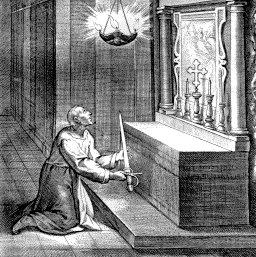
The sword of Saint Ignatius
This excerpt from the Autobiography speaks to the significance of Ignatius’ sword:
He continued on his way to Montserrat, pondering in his mind, as was his wont, on the great things he would do for the love of God. And as he had formerly read the stories of Amadeus of Gaul and other such writers, who told how the Christian knights of the past were accustomed to spend the entire night, preceding the day on which they were to receive knighthood, on guard before an altar of the Blessed Virgin, he was filled with these chivalric fancies, and resolved to prepare himself for a noble knighthood by passing a night in vigil before an altar of Our Lady at Montserrat. He would observe all the formalities of this ceremony, neither sitting nor lying down, but alternately standing and kneeling, and there he would lay aside his worldly dignities to assume the arms of Christ.
When he arrived at Montserrat, he passed a long time in prayer, and with the consent of his confessor he made in writing a general confession of his sins. Three whole days were employed in this undertaking. He begged and obtained leave of his confessor to give up his horse, and to hang up his sword and his dagger in the church, near the altar of the Blessed Virgin. This confessor was the first to whom he unfolded his interior, and disclosed his resolution of devoting himself to a spiritual life. Never before had he manifested his purpose to anybody.
Ignatius offers up his sword
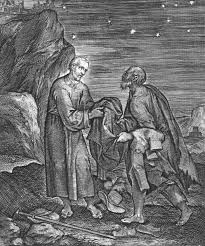
The eve of the Annunciation of Our Blessed Lady in the year 1522 was the time he chose to carry out the project he had formed. At nightfall, unobserved by any one, he approached a beggar, and taking off his own costly garments gave them to the beggar.
Ignatius gives his fine clothes to a beggar (from The Life of Saint Ignatius by Peter Paul Reubens)
He then put on the pilgrim’s dress he had previously bought, and hastened to the church, where he threw himself on his knees before the altar of the Blessed Mother of God, and there, now kneeling, now standing, with staff in hand, he passed the entire night.
The street where Saint Ignatius lived in Barcelona
The place in Sant Maria del Mar where Ignatius used to sit when he was begging
The matress and the chair of Saint Ignatius
Our final dinner together
Over dinner we shared our experiences with Josep Lluís and made recommendations about ways in which the Ignatian Camino could be improved. One of the things he told us was that we were the first organised group of pilgrims to walk the entire way from Loyola to Manresa. We are honoured to have achieved this.
Today was our final stage of the Ignatian Camino, the descent from Montserrat to Manresa. Before we left we walked over to the Basilica and venerated the Black Madonna.
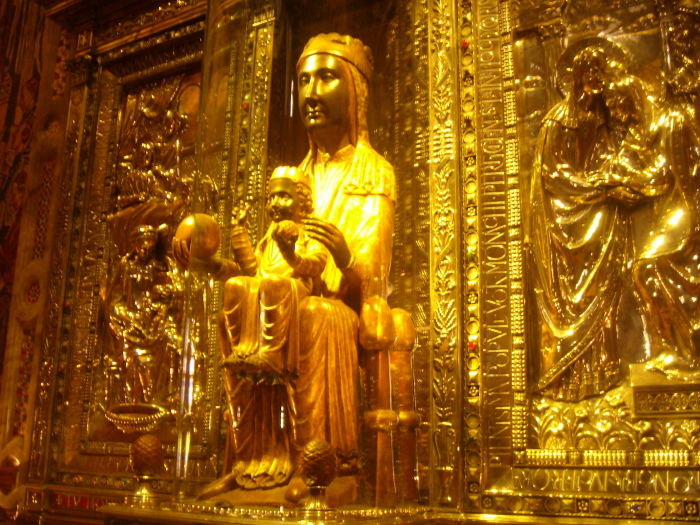
The Black Madonna at Montserrat
A look back at our hotel tucked in under the mountain
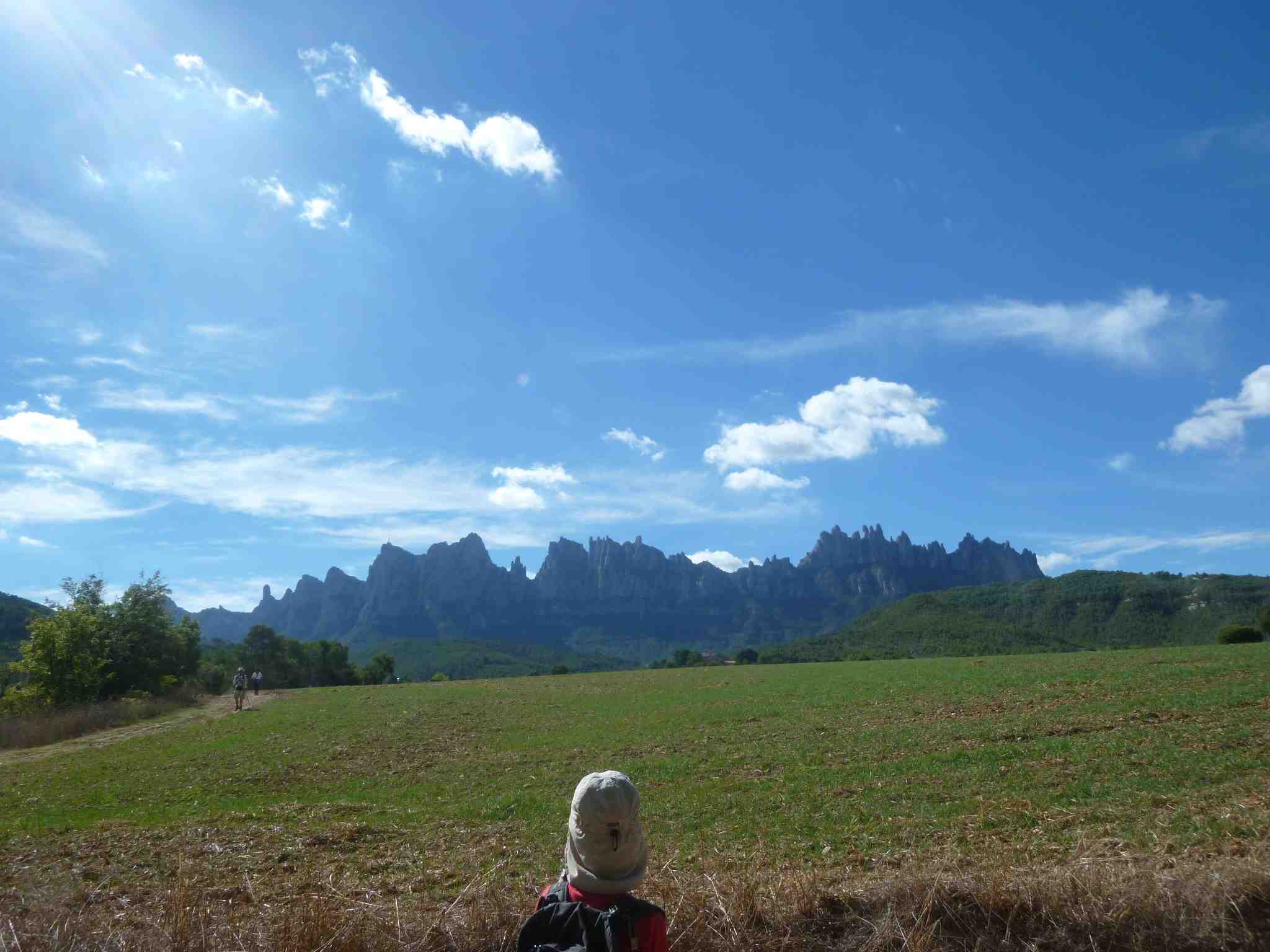
Amanda looking back at Montserrat (the serrated mountain)
I anticipated that this would be an easy day, but it was difficult. The weather was hot — Larry Naismith said it was 34°C — and it was humid. It felt as though it was the hottest day we had walked in.
Me keeping cool in the middle of a very hot afternoon
Trying to keep cool in 34C heat
The track down from Montserrat was very rocky
John Fitzgerald, Amanda Hickey and Patrick Hynes walking down an old Roman road built in the Third Century
Our first view of the Centre of Ignatian Spirituality at Manresa
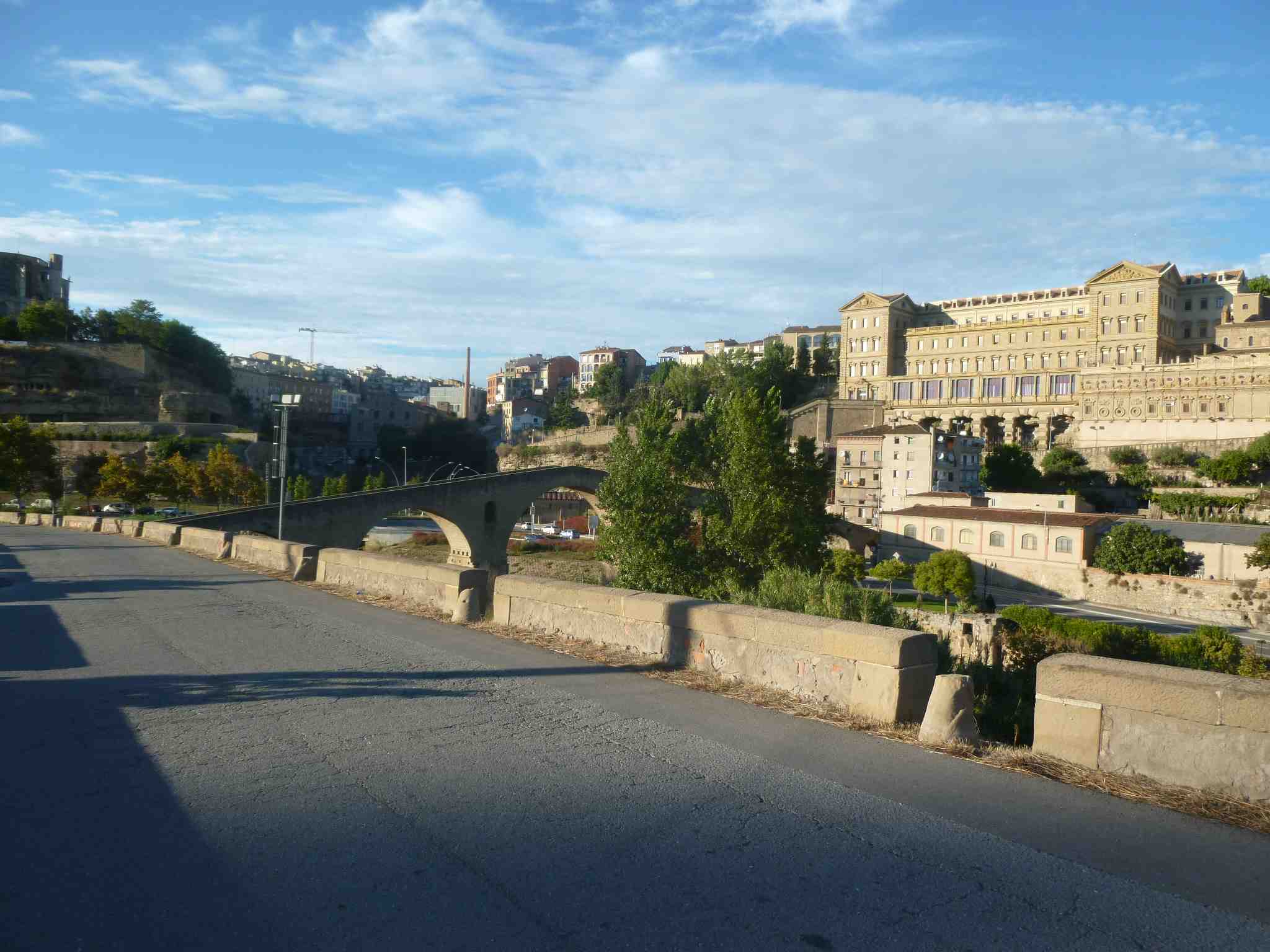
The bridge across the Cardoner River
Today we were following in the footsteps of Ignatius of Loyola who we know walked from Montserrat to Manresa on March 25th, 1522. He lived in Manresa for the next eleven months. His favourite place to pray was the Cave; a natural grotto facing Montserrat and over which the Church, the Jesuit Residence and the Retreat House are built. His experiences there would bear fruit in his spiritual masterpiece, the Spiritual Exercises.
Michael Bertie told us at dinner this evening that, according to his GPS, we have walked 686 km since we left Loyola.
This evening I said Mass for the group in the cave where Ignatius composed his Spiritual Exercises. It was a great privilege.
Michael Smith, Tracy Ling and Paddy Mugavin Mass in the cave at Manresa
Mass in the cave with Tracy, Paddy and Amanda
Late in life, Ignatius dictated a short Autobiography. In it he summarized the depth of his experiences at Manresa, and in particular while he sat beside the River Cardoner:
He sat down for a little while with his face toward the river…While he was seated there, the eyes of his understanding began to be opened; not that he saw any vision, but he understood and learned many things…with so great an enlightenment that everything seemed new to him.” He added, “even if he gathered up all the various helps he may have had from God, he does not think he had got as much as at that one time.
Contemplation to attain the love of God
Today I suggested an “Ignatian repetition” — we repeated the same meditation as yesterday, but this time we focused on the time of pilgrimage. We reviewed the various stages of our journey and we thanked God for the experiences we have had and the blessings we received as we prepare to return to our everyday routine.
The grace. Today I ask the Father to give me an intimate knowledge of the many gifts I have received during this pilgrimage so that, filled with gratitude for all of these, I may love and serve the Divine Majesty in everything I undertake.
I also spoke to the group about the difficulties of re-entry after an experience like this.
We had a half an hour sleep in this morning because of our very long and tiring day yesterday and the fact that we all got to bed late after a late dinner. We gathered outside the hotel at 8.30am. Led by Fermin Lopetegui, our Basque guide, we followed in the footsteps of Saint Ignatius as we walked through picturesque countryside to the Benedictine Basilica of Montserrat.
Michael standing beside a sign in Catalan announcing the Ignatian Camino
Pilgrims coming around the bend
Today was a difficult stage with some steep sections. Along the way, however, we enjoyed the craggy mountain scenery of the Montserrat mountain which rises majestically up to 1,235 metres. The bizarre rock formations in Montserrat create a unique universe in stone, and the landscape and the views are breathtaking.
Rock climbers on Montserrat, one waving at us
Our first view of Montserrat
The Monastery complex has been one of Spain’s most important pilgrimage sites for hundreds of years, due to its famous 12th century Romanesque wooden carving of the revered Virgen Moreneta, the “Black Virgin”. The history of Montserrat dates to the 9th century, when a small group of shepherd children saw a bright light descending from the sky in the Montserrat mountains. Montserrat was an important stop on the pilgrimage for Saint Ignatius, and it is said that he experienced a vision of the Virgin Mary and infant Jesus while at the shrine. The cave chapel known as “Santa Cova”, is where (according to legend) the Virgin Mary was seen by the shepherds.
At Montserrat Ignatius laid down his sword at the shrine of the Black Madonna in a symbolic embodiment of his surrendering his former courtly and military life for a new life devoted to the service of Jesus.
We are staying at the Hotel Abat Cisneros in Montserrat which is housed within a converted monastery building that has welcomed pilgrims since the 16th century, the hotel is situated in the heart of the Sanctuary of Montserrat, adjacent to the Basilica.
At 6.45pm we went to Vespers with the Benedictine Monks in the Basilica who were joined by a boy’s choir afterwards.
After Vespers I said Mass for some members of the group in a chapel that is behind the statue of the Black Madonna.
Contemplation to attain the love of God
Today as we walked we prayed the Contemplation to attain the Love of God.
For Ignatius, God is in the wild flowers we see along the tracks, God is in the river stones on the pathway, God is in the clear blue skies overhead, God is in the grandeur of Montserrat. In short, God can be found in all things. Today we pray on what God gives to us and what we give to God.
Preliminary Note: Before this exercise is presented, two observations should be made:
the first is that love ought to show itself in deeds over and above words;
the second is that love consists in a mutual sharing of goods. For example, as a lover one gives and shares with the beloved something of one’s own personal gifts or some possession which one has or is able to give; so, too, the beloved shares in a similar way with the lover. In this way, one who has knowledge shares it with the one who does not, and this is true for honors, riches and so on. In love, one always wants to give to the other.
Preparation: I take the usual time to place myself reverently in the presence of my Lord and my God, begging that everything in my day is directed more and more to God’s service and praise.
At this time, I may find it especially helpful as I enter into this prayer to imagine myself standing before God and all the saints who are praying for me.
Grace: I beg for the gift of an intimate knowledge of all the goods which God lovingly shares with me. Filled with gratitude, I want to be empowered to respond just as totally in my love and service.
The Setting: There are four different focal points which provide the subject matter for my prayer:
1. God’s gifts to me
God creates me out of love which desires nothing more than a return of love on my part. So much does God love me that even though I turn away and make little response, this Giver of all good gifts continues to be my Savior and Redeemer.
All my natural abilities and gifts, along with the gifts of Baptism and the Eucharist and the special graces lavished upon me, are only so many signs of how much God our Lord shares divine life with me and wants to share ever more. My consolation: who I am by the grace of God!
If I were to respond as a reasonable person, what could I give in return to such a Lover? Moved by love, I may want to express my own love-response in the following words:
Take, Lord, and receive all my liberty; my memory, my understanding, and my entire will—all that I have and call my own. You have given it all to me. To you, Lord, I return it. Everything is yours; do with it what you will. Give me only your love and your grace. That is enough for me.
2. God’s self-giving to me
God not only gives gifts to me, but God literally gifts me with the fullness of divine life in Jesus. God’s only Son is not only the Word in whom all things are created, but also the Word who becomes flesh and dwells with us. Jesus gives himself to me so that his Body and Blood become the food and drink of my life. Jesus pours out upon me his Spirit so that I can cry out “Abba, Father.” God loves me so much that I become a dwelling place or a temple of God—growing in an ever-deepening realization of the image and likeness of God which is the glory shining our of human creation.
If I were to make only a reasonable response, what could I do? Moved by love, I may find that I can respond best in words like the Take and Receive.
3. God’s labours for me
God loves me so much, even entering into the very struggle of life. Like a potter with clay, like a mother in childbirth, or like a mighty force blowing life into dead bones, God labors to share divine life and love. God’s labors are writ large in Jesus’ passion and death on a cross in order to bring forth the life of the Resurrection.
Once more I question myself how I can make a response. Let me look again to the expression of the Take and Receive.
4. God as Giver and Gift
God’s love shines down upon me like the light rays from the sun, or God’s love is poured forth lavishly like a fountain spilling forth its waters into an unending stream. Just as I see the sun in its rays and the fountain in its waters, so God pours forth a sharing in divine life in all the gifts which showered upon me. God’s delight and joy is to be with the ones called God’s children—to be with me. God cannot do enough to speak out and show love for me—ever calling and inviting me to a fuller and better life, a sharing in divine life.
What can I respond to such a generous Giver? Let me once again consider the expression of the Take and Receive. I close the prayer with an Our Father.
The bus was due to pick us up from the hotel in Tarrega at 8.00am, and drive us to Cervera. But because of some miscommunication the bus didn’t arrive until 9.00am. This meant that by the time we drove to Cervera and began walking it was 9.40am — the latest we had ever begun a day and this on the longest stage of the Ignatian Camino.
Tracy and Vin looking down from the battlements of Cervera
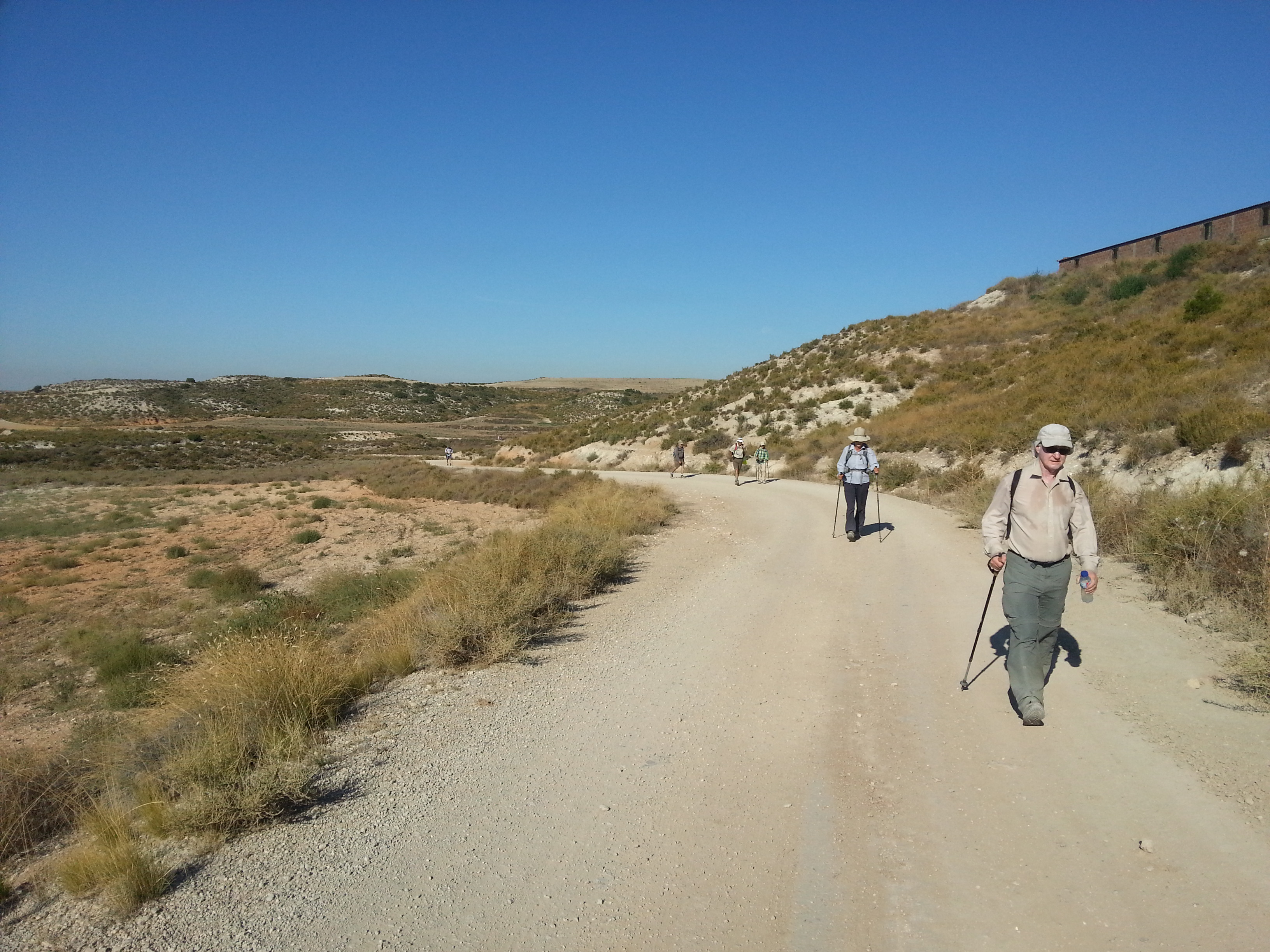
Today was a long and challenging day. The official route is 37 km, but by the time we had walked from the bus to the starting point of the official route and then by the time we walked to our hotel at the end of the day Michael Bertie’s GPS showed that we had walked 41.1 km — not far short of a marathon. We arrived at the hotel in Igualada at 7.45pm — 10 hours on the road.
The pilgrim way
The landscape began to change as we approached more hilly terrain. We passed through six or seven small villages where we could pause for a rest. In one of them (Pallerols), we found a beautiful 12th century Romanesque church dedicated to Saint James. In one small village, Sant Pere dels Arquells near Cervera, we came across three Soviet-era MIG jet fighters in someone’s backyard. Intriguing. This small and rusty air force is composed of a MiG-15, a Bulgarian MiG-21 and a Czechoslovakian MiG-23.
Soviet era MIG jet fighters
Walking along he highway
We has a wonderful surprise when we arrived at Panadella for lunch. There was our old friend Fermin Lopetegui, our Basque guide.He is going to join us in walking the last two stages to Montserrat and Manresa.
Fr Paddy Mugavin meeting up with Fermin Lopetegui again
About 10 km out of Igualada we had our first view of Montserrat. We will walk there tomorrow.
Our first view of Montserrat
My feet felt battered and sore by the time we arrived in Igualada, a large and important city in Cataluña.
In Igualada it is believed that Ignatius bought the “sturdy cloth robes” that he intended to wear. It is also here that Ignacio decided on the prayer vigil that he would underterake in Montserrat. The Autobiography of Saint Ignatius reads:
Arriving at a large village not far from Montserrat, he decided to purchase a garment to wear on his journey to Jerusalem. He therefore bought a poorly-woven piece of sackcloth, filled with prickly wooden fibers. Out of this me made a garment that reached his feet. He also bought a pair shoes of coarse material often used to make brooms. He never wore but one shoe, not for the sake of the comfort he derived, but because this leg would be quite swollen from riding on horseback all day since for mortification he wore a cord tied tightly just below the knee. For this reason he felt he ought to wear a shoe on that foot. He also bought a pilgrim’s staff and a gourd to drink from. These he tied to his saddle.
The Grace we pray for today: I beg the Father for this gift: to enter into the joy of the risen and victorious Christ. To be able to contemplate the fullness of life that Jesus has achieved for us. I ask to rejoice deeply with Christ, and to be sent into the world to serve the mission of Jesus Christ.
Reflections: When we experience the grace of the resurrection it is not just a personal gift. Rather, it is a gift to be shared with others. When we are touched by God we are led into the service of Jesus’ mission: to spread the Good News of the Kingdom of God.
A favourite image of God for Saint Ignatius was God the Worker, Deus Operarius. Ignatius saw God labouring that the world might be transformed and brought into final union with the divine. We in our turn are called to cooperate with God in bringing about God’s project in our world. Our projects and practices are united to God’s project.
Ignatius of Loyola was a mystic whose love of God was expressed in apostolic service. He wanted to find God’s will and carry it out in loving service. Likewise, he desired “to help souls” so that they too would “surrender completely to the service of God” (Autobiography, No 79).
Ignatius’ mysticism and its apostolic expression were inextricably linked. Ignatius’ love of neighbour flowed from his mysticallove of God. For Ignatius discerned action for building the Kingdom of God was a constitutive element of his contemplation.
The Exercises of Saint Ignatius are designed to lead the one who makes them to serve God and neighbour. The question is, of course, how this spiritual consolation will be incarnated in his or her life. The question which the pilgrims have addressed today is: how will the graces of the Ignatian Camino be incarnated (made real in history) In my life when I return home?
This is not just about what we are called to do although that is critically important. It is also about who we are called to be. Karl Rahner writes: “Grace is the quality of one’s personal presence to the world.”
The Father continues to pour out the Spirit of Christ upon us. Jesus consoles us always and sends us forth on mission to console the suffering, the poor, and all who long for salvation. As it is written: We might be called to work in a slum, a laboratory, a church, a clinic, an office, a classroom. Jesus gives us our mission: go forth, baptize, teach, love, and bring God’s Compassion as reconciliation for all of humanity. We are invited to fulfill this mission in every moment and circumstance of life. And Jesus speaks the most wonderful words to us: He promises that He will be with us always, in each joyful and painful moment. Even though I may not feel worthy to accept His presence, Jesus will always stay close to me. Even if I am a sinful person, unfaithful and limited, Jesus is going to send His Spirit to transform every human situation as an experience of growth.
Even though our faith may be small, Jesus counts on us. Thomas had to recognize his lack of faith before being sent to the world. We pray to answer the call of Jesus, inviting us to follow him to the beach and stay with Him. We join the disciples there in receiving His commission and His blessing.
Scripture:
Matthew 28: 16-20: “I will be with you always, until the end of time.”
John 20: 24-29: Tolerant of my darkness and unbelief as He was of Thomas, Jesus delights in consoling me with the gift of renewed faith. In His loving presence, I say: “My Lord and my God!”
John 21: 1-17: A moment of joy – “It is the Lord!” A moment of companionship – “Come and eat your meal.” A moment of intimacy and decision – “Do you love me?” A moment of mission – “Feed my sheep!”
Final Colloquy: At this point in our interior pilgrimage, we are accustomed to walk with our friend and Lord Jesus Christ, speaking freely just as one friend does with another. If you honestly experience the strength and grace within you, beg Jesus to accept you under His banner, thus to build the Kingdom of God at His side. Finish with the “Our Father.”
In the morning the bus took us back to Verdú to commence the next walking stage which was another short one of 16 km. We faced a problem however — how would we know the result of the Australian Football League Grand Final between Hawthorn and Fremantle? Fortunately both Vin Dillon and Fr Joe Taylor had purchased Spanish SIM cards for their iPads and we were able to listen to the Australian Broadcasting Corporation’s coverage of the match by live streaming as we walked along.
Vin Dillon listening to the AFL Grand Final on his iPad
Hawthorn have hit the front
We walked for just an hour to Tàrrega where we stopped to visit the Church of Santa Maria de l’Alba. It was exquisite example of an old church which has been refurbished beautifully.
Walking into Tarrega
Santa Maria del Alba Church in Tarrega
Chona Walden venerating the Cross
Fr John Fitzgerald with symbols of the Crucifixion
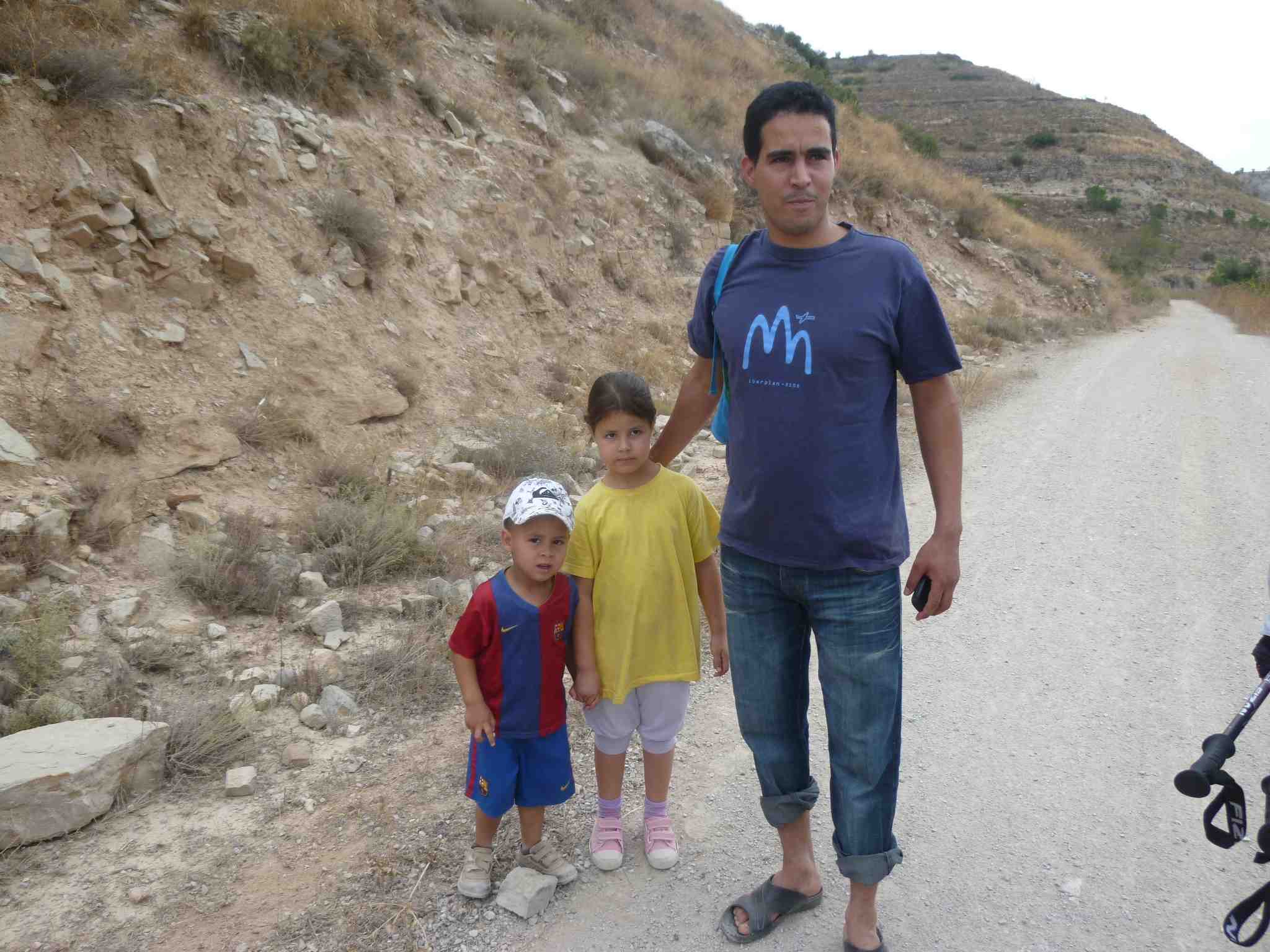
We stayed for an hour and then moved on to Cervera. On the way we met a Muslim man, originally from Morocco, who was walking with his two children.
Mohammed and his daughter Fatima and son
While today was short, the weather was humid and the hill up to Cervera was steep. Traces of the town’s 18th century splendour can still be seen in its buildings and old city walls. In the impressive main square stand several historic buildings dating back to the 17th century.
Having a drink at our destination — Cervera
Cervera’s main square
After we explored the town, we returned to Tárrega by bus.
Prayer: Today we paid special attention to the colloquy as an important element in Ignatian spirituality.
“The colloquy is made, properly speaking, as one friend speaks to another … communicating one’s affairs, and asking advice in them” [54].
The colloquy is the conversation in which you can engage at any time during a prayer exercise although Ignatius places it at the end of each prayer exercise. This dialogue can be with Jesus, with God the Father, with the Holy Spirit, with Our Lady. It is made when you feel moved to make it — as a friend with a friend.
During the colloquy,
you pour out your thoughts to God
you talk over what is happening in your experience, be it temptations, desolations, consolations, or desires
you talk over what you need — seeking advice, inquiring how you could be more open, asking for enlightenment as to some particular issue and so on.
Like any conversation, it is a dialogue. Monologues are not conversations; nor are they colloquies. The Colloquy is a two-way conversation. You may find that you have no trouble talking to Jesus or God as father but you may fail to talk with them. The Colloquy is a conversation and conversation is dialogical.
The Colloquy is an instrument of discovery and freedom. When you talk out your experiences and pour out your thoughts, there is a release of the less-than-conscious areas of your heart. Revelation and discovery come both from within yourself and from the grace of God’s enlightenment. Often you begin the Colloquy in one fashion, then forget yourself in the conversation and discover yourself saying things and expressing deeper and unexpected desires. In the development of these desires and in their indication of growing spiritual freedom, you recognize the impulse of the Spirit. Jesus can bring a new perspective — His — to the issue that you are bringing to him.
As you pray feelings and thoughts about life will surface through your prayer. As these feelings and heartfelt thoughts become more evident, express them to God. Talk to God about these feelings. Don’t be afraid to express how you really feel when you are at prayer. Sometimes it helps to imagine Jesus sitting across from you. Tell him what is on your mind and what is in your heart. Then be silent and imagine Jesus responding to you. Together you enter into conversation. Make your inner reactions available to Jesus.
When you are unaware of deeper reactions being touched off in your prayer, God seems distant or impersonal. It is as if you are hiding something from the one you love. When you hide something from someone you love, you feel more distant from that person. You may do this to remain on safe territory. There is no significant growth in prayer unless God is allowed to influence your real interior reactions that are presently needing to surface.
Prayer:
Imagine that the Risen Lord walking with you today along the dusty road….
Tell him you believe he is walking with you…
Reflect on the fact that he loves and accepts you just as you are now… Take time out to sense his unconditional love for you as he looks at you lovingly and humbly.
Speak to the Risen Lord… or just lovingly stay in silence and communicate with him beyond words.
I suggested thatJohn 21:15-17 was an example of a Colloquy, and that maybe we might hear Jesus call us by our name and ask, “Do you love me?”
When they had finished eating, Jesus said to Simon Peter, “Simon son of John, do you love me more than these?” “Yes, Lord,” he said, “you know that I love you.” Jesus said, “Feed my lambs.” Again Jesus said, “Simon son of John, do you love me?” He answered, “Yes, Lord, you know that I love you.” Jesus said, “Take care of my sheep.” The third time he said to him, “Simon son of John, do you love me?” Peter was hurt because Jesus asked him the third time, “Do you love me?” He said, “Lord, you know all things; you know that I love you.” Jesus said, “Feed my sheep.
The bus took us back to Castellnou de Seanu. Today was a light day — only 18 km. But it was hot. We started with the “Pilgrim Song”:
Then we commenced a short day of walking, along farm roads.
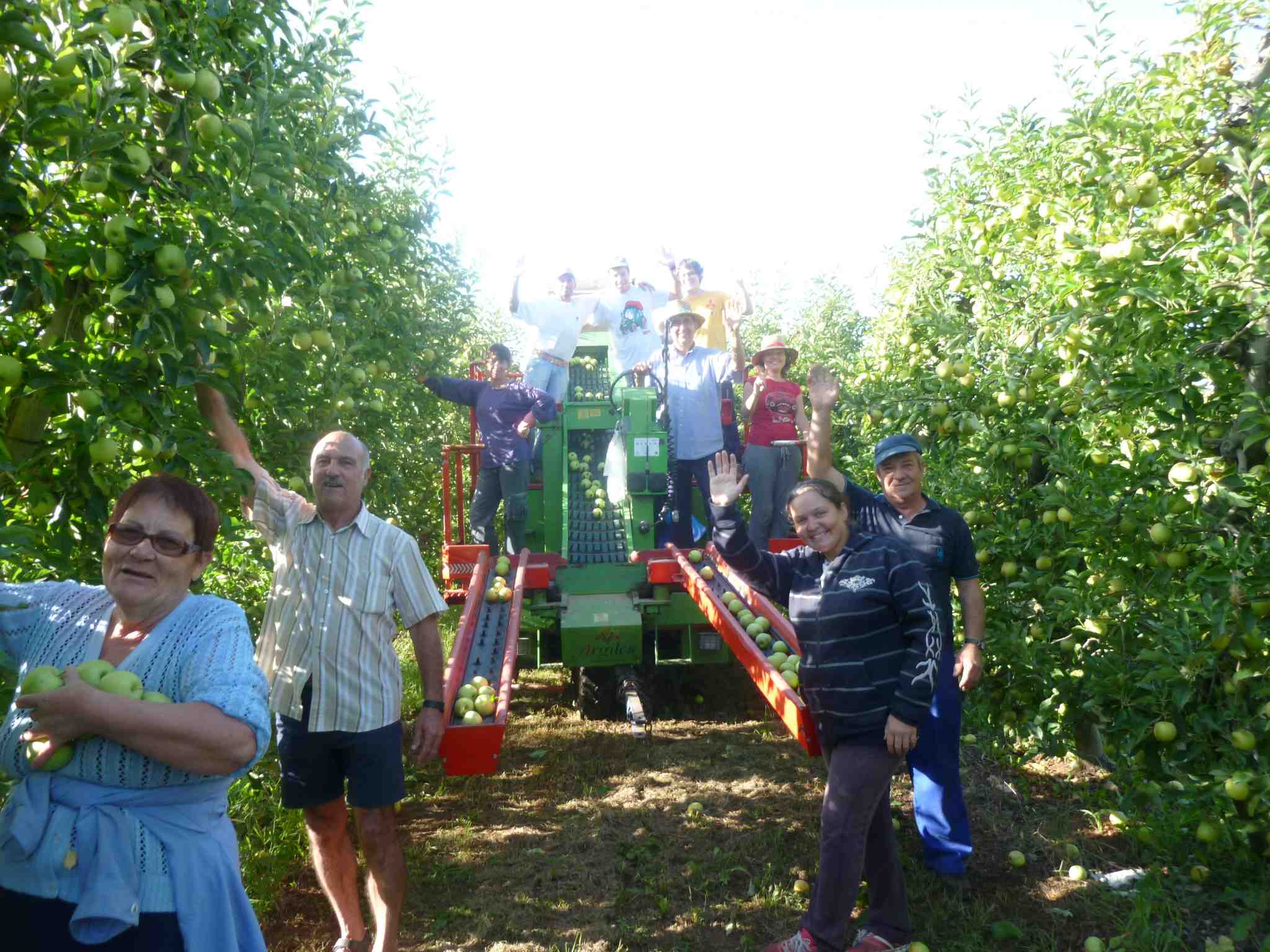
Apple pickers who gave us the most delicious apples
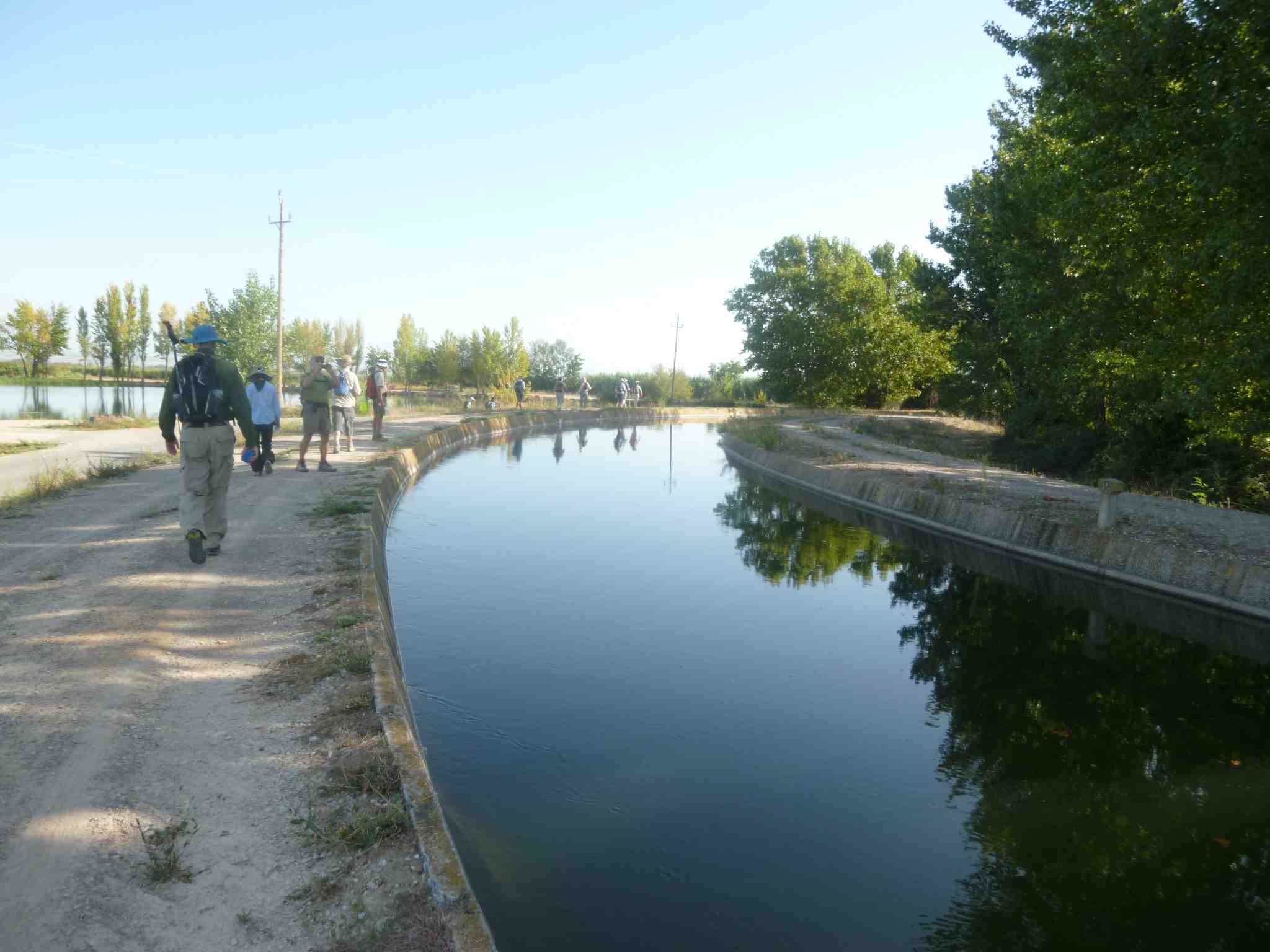
In the morning we walked for a while beside a canal
Walking beside the canal
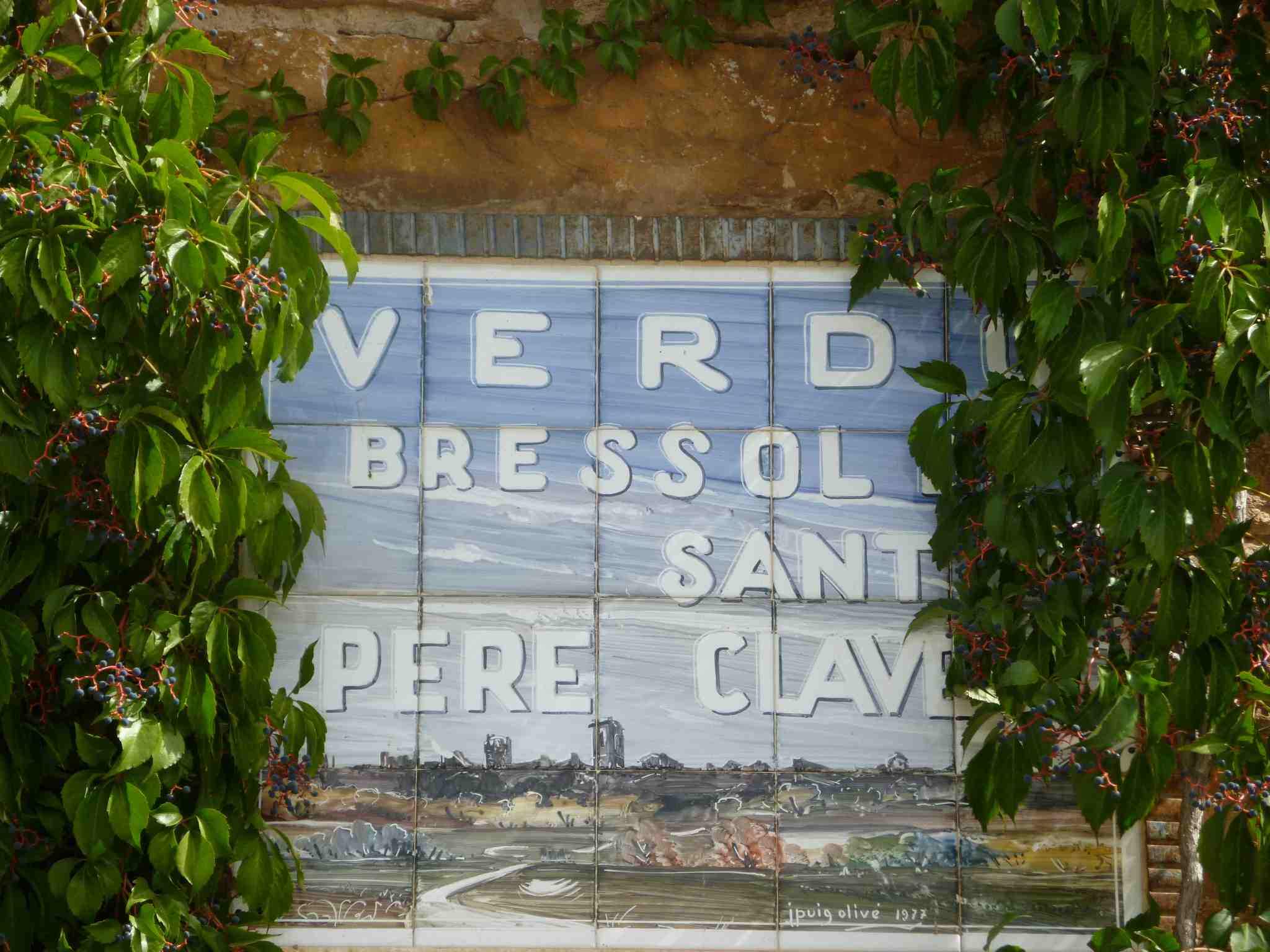
Our destination was Verdú, a small village with great significance for the Society of Jesus in Cataluña, as it is here that the Jesuit Saint Pierre (Peter) Claver was born and raised.
St Peter Claver’s family home in Verdu
Sign on St Peter Claver’s house
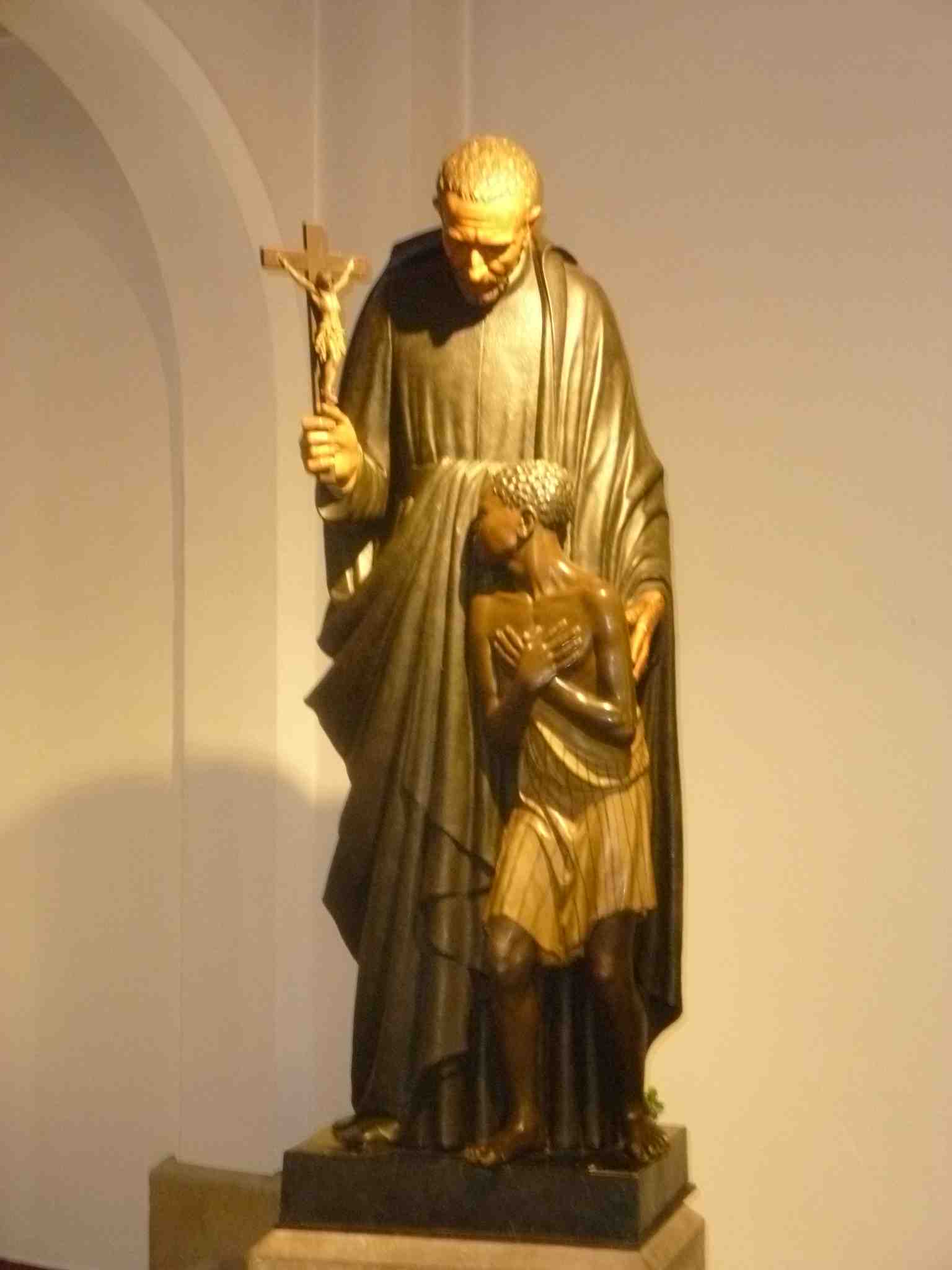
Statue of St Peter Claver in the Church
He would later become known as the “holy defender of the black slaves” in the port of Cartagena de Indias (Colombia).
St Peter Claver
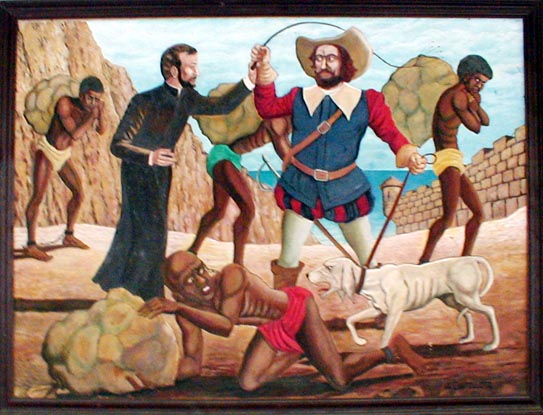
This was a dark time in history, stained by the injustice and cruelty of slavery. According to Glen David Short:
Between the 16th and the 19th centuries more than 14,000,000 Africans were forcibly brought to the Americas. Hunted down like animals, they were chained together and loaded aboard the dark, damp, stinking hold of ships bound for the New World. Shipboard conditions were sickening, and beyond human description. One third of the “cargo” was spared, for they died en route. In Cartagena they were sold in markets.
Peter Claver was a witness to the arrival of slave ships, and saw how the slaves were treated. He began to go to the port when a ship arrived, welcoming them with an open heart and a smile on his lips, at the same time distributing clothing, food, drink and sweets. He wrote that he spoke to them not with words but with his hands and work. It was useless to speak to them any other way. He would kneel beside the sick, wash them, tend to them, and try to make them happy with as many demonstrations of care that human nature can show to help lighten the burden of a sick person. His life was a beautiful example of human and evangelical love for his dear slaves. He cared for them materially, instructed them in the faith, and baptized them, always considering himself their servant. On April 3, 1622, he made a solemn commitment which he expressed with the following words: “Slave of the Black Slaves forever.”He signed it, and fulfilled it with his life.
Here is some additional information about this Jesuit saint:
St Peter Claver was a Spanish Jesuit who gave his life in service to slaves in Columbia in Latin America. He was born in 1580 into a noble but not well-off family in Verdu in Spain and studied in Barcelona. He entered the Society of Jesus in 1601. When he studying philosophy in the Jesuit college in Majorca, Claver was encouraged by the saintly Brother Alphonsus Rodriguez to go to the new missions in America and save “millions of perishing souls.” In 1610 he landed in Cartagena, Columbia and, after completing his studies in Bogotá, he was ordained in 1616.
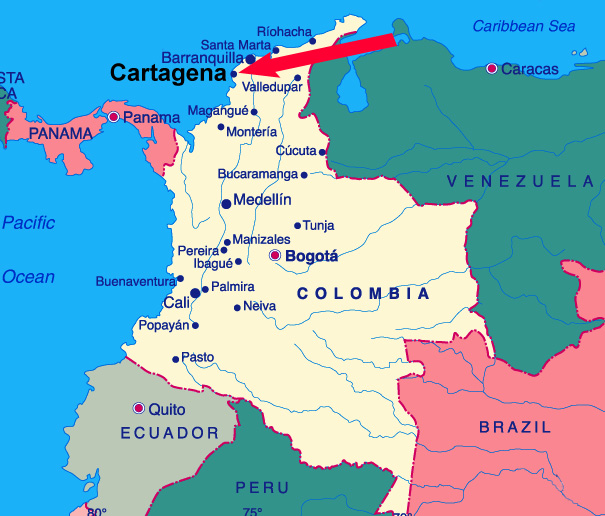
Map of Cartagena
Cartagena was one of two ports where slaves from Africa arrived to be sold in South America. For 33 years, from 1616 to 1650, Peter Claver worked daily to minister to the needs of the 10,000 slaves who arrived each year.
When a ship arrived, Peter first begged for fruits, biscuits, or sweets to bring to the slaves. He then went on board with translators to bring his gifts as well as his skills as a doctor and teacher. Claver entered the holds of the ships and would not leave until every person received a measure of care. Peter gave short instruction in the Catholic faith and baptized as many as he could. In this way he could prevail on the slave owners to give humane treatment to fellow Christians.
The treatment of slaves
He was accused of being overzealous, and of having profaned the Sacraments by giving them to creatures who scarcely possessed a soul. The fashionable women of Cartagena refused to enter the churches where Father Claver assembled the slaves. His superiors were often influenced by his critics and some tried to curtail his activities. By 1651 he had baptized more than 300,000, when he at last became weakened by the plague.
In the last years of his life Peter was too ill to leave his room and he was poorly cared for. Claver never complained. He was convinced that he deserved this treatment.
When Cartagenians heard that Peter Claver was dying, they crowded into his room to see him for the last time. They treated Peter Claver’s room as a shrine, and stripped it of everything but his bedclothes for mementos. He died on 8 September 1654.
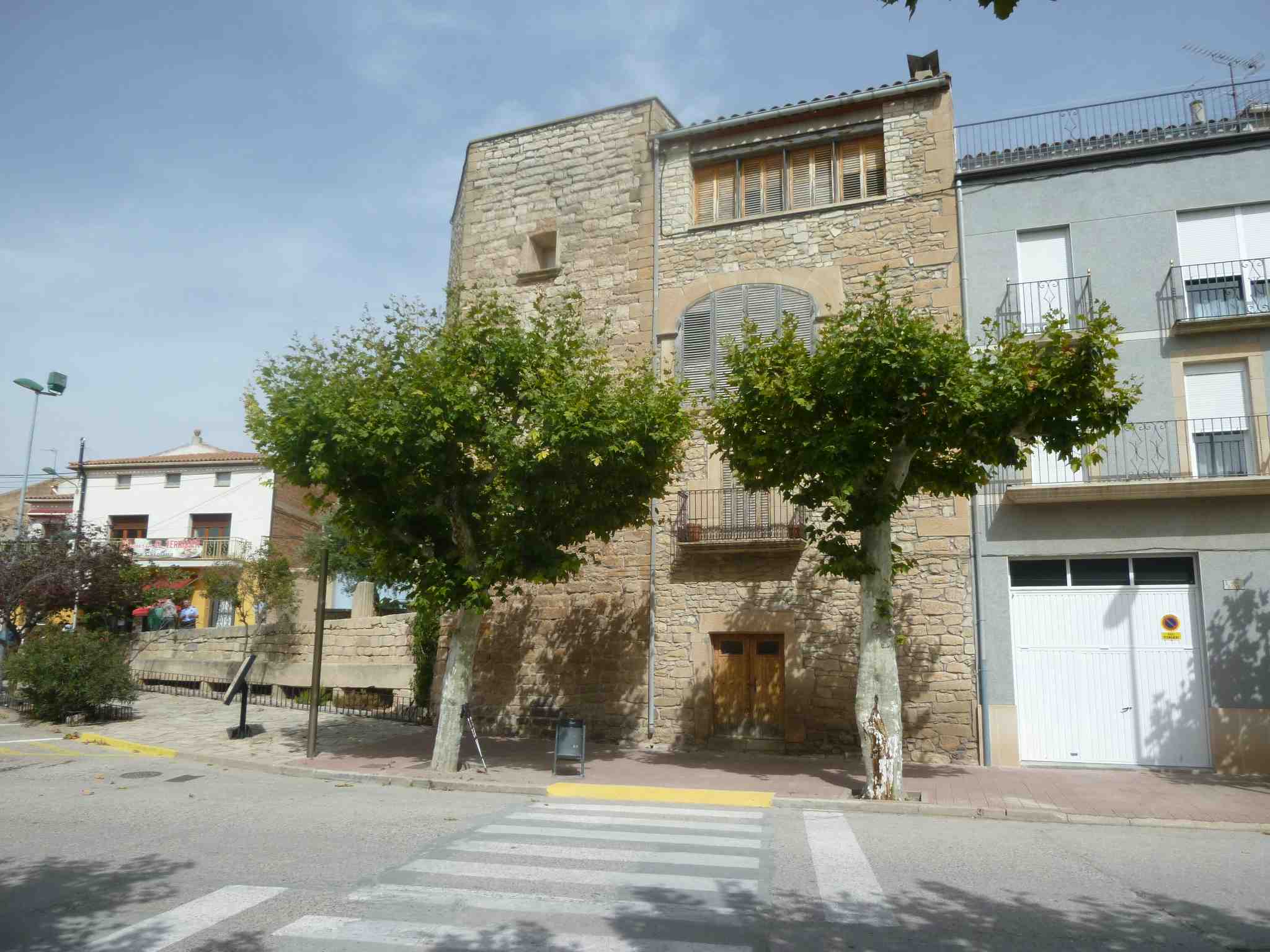
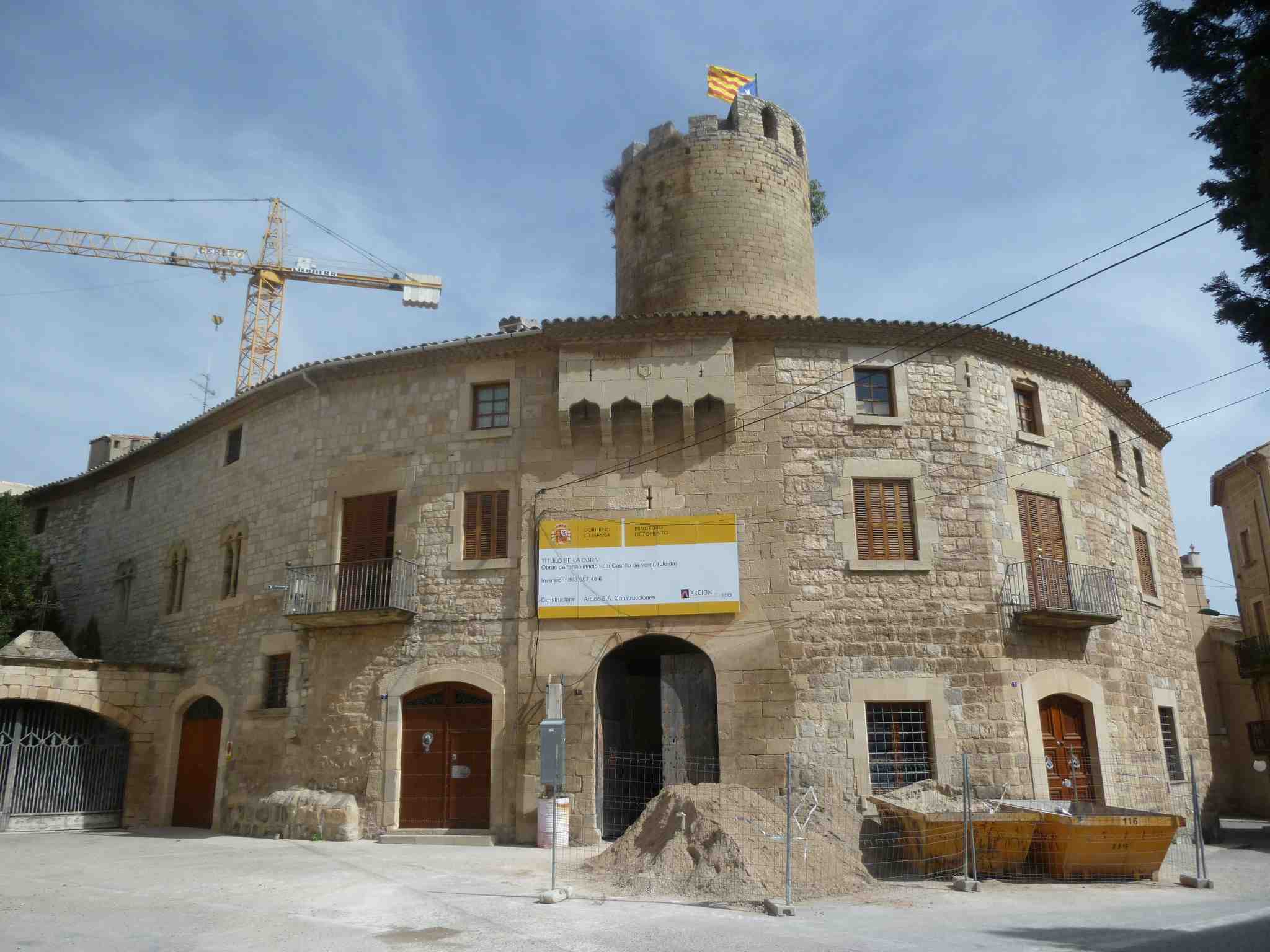
The town of Verdú. The most important religious monument in Verdú is the 13th century parish church of Santa Maria, with its Romanesque portal. Inside are the 15th century Gothic sculptures of the Virgin, in polychrome stone, and that of Saint Flavia, patron saint of the town. Beside the church stands the 12th century castle, around which the community developed. The castle is currently being restored.
The Castle in Verdu
Workmen restoring the interior of the castle
Prayer: Today we focused our contemplation on the experience of Mary Magdalene as she goes to the tomb in the early morning (John 20:11-18). I invited the pilgrims to hear, as Mary Magdalene did, the Risen Jesus speak their names with love:
He asked her, “Woman, why are you crying? Who is it you are looking for?” Thinking he was the gardener, she said, “Sir, if you have carried him away, tell me where you have put him, and I will get him.” Jesus said to her, “Mary.” She turned toward him and cried out in Aramaic,“Rabboni!” (which means “Teacher”).

















 Walking with Inigo — The Ignatian Camino