Speaking with God as you walk the Ignatian Camino

Just before we started our first stage of walking — from Loyola to Zumarraga — I spoke to the group about three of the most important processes in Ignatian spirituality, namely, (i) desire (the id quod volo — asking God for what it is I desire), (ii) the use of the imagination in the composition of place, and (iii) the colloquy. Concerning the colloquy, Saint Ignatius writes in his Spiritual Exercises:

“The colloquy is made, properly speaking, as one friend speaks to another … communicating one’s affairs and asking advice in them” [SpEx. 54].

The colloquy is the conversation in which you engage at any time during a prayer exercise. This dialogue can be with Jesus, with God the Father, with the Holy Spirit, with Our Lady, with God, with a saint, etc.

The colloquy is a conversational technique intended for any moment during the prayer exercise. It is made when you feel moved to make it. At times you enter into such a colloquy when you pray for the Grace [id quod volo]. It is made as a friend with a friend [54]; during it, you pour out your thoughts to God [53]; during it, you talk over what is happening in your experience, be it temptations, desolations, consolations, or desires. You talk over what you need—seeking advice, inquiring how you could be more open, asking for enlightenment as to some particular issue [199]. Like any conversation, it is a dialogue. Monologues are not conversations; nor are they colloquies. The colloquy is an instrument of discovery and freedom. When you talk out your experiences and pour out your thoughts, there may be a release from some of painful experiences that shadow your heart. Revelation and discovery come both from within yourself and from the grace of God’s enlightenment. Often you begin the colloquy in one fashion, then forget yourself in the conversation and discover yourself saying things and expressing deeper and unexpected desires. In the development of these desires and in their indication of growing spiritual freedom, you recognize the impulse of the Spirit.

The colloquy is a two-way conversation. You may find that you have no trouble talking to Jesus or God as Father, but you may fail to talk with them. The colloquy is a conversation and conversation is dialogical. As you pray, feelings and thoughts about life will surface through your prayer. As these feelings and heartfelt thoughts become more evident, express them to God. Talk to God about these feelings.  Don’t be afraid to express how you really feel when you are at prayer. Sometimes it helps to imagine Jesus walking the Ignatian Camino with you. Tell him what is on your mind and what is in your heart. Then be silent and imagine Jesus responding to you. Together you enter into a conversation. Make your inner reactions available to Jesus.

When you are unaware of deeper reactions being touched off in your prayer, God seems distant or impersonal. It is as if you are hiding something from the one you love. When you hide something from someone you love, you feel more distant from that person. You may do this to remain on safe territory. There is no significant growth in prayer unless you allow God to influence your real interior reactions that are presently needing to surface.

Example of Colloquies: excerpts from the Journal of a Soul

Angelo Roncalli, (Pope John XXIII) February 1900, writing as an eighteen-year-old seminarian in Bergamo, Italy:

Who am I? Where do I come from? Where am I going? I am nothing. Everything I possess, my being, life, understanding, will and memory—all were given me by God, so all belong to him. Twenty short years ago, all that I see around me was already here. Everything was proceeding in its appointed way under the watchful eyes of Divine Providence. And I? I was not here. Everything was being done without me, nobody was thinking of me, nobody could imagine me, even in dreams, because I did not exist. And you, O God, with a wonderful gesture of love, you who are from the beginning and before all time, you drew me forth from my nothingness, you gave me being, life, a soul, in fact all the faculties of my body and spirit; you opened my eyes to this light which sheds its radiance around me, you created me. So, you are my Master, and I am your creature. I am nothing without you, and through you I am all that I am. I can do nothing without you; indeed, if at every moment you did not support me, I should slip back whence I came, into nothingness.

June 1957, as Patriarch of Venice: “Give me more light as evening falls.”

O Lord, I am now in the evening of my life. I am in my seventy-sixth year. Life is a great gift from our heavenly Father. Three-quarters of my contemporaries have passed over to the far shore. So, I too must always be ready for the great moment. The thought of death does not alarm me. Old age, likewise, a great gift of the Lord’s, must be for me a source of tranquil inner joy, and a reason for trusting day by day in the Lord himself, to whom I am now turned as a child turns to his father’s open arms.

Identity—my deepest desires reveal who I am[1]

A DESIRE IS AN INCLINATION towards some object (or person) accompanied by a positive affect (or feeling). The quality of a desire comes from the object whereas the intensity comes from the affect.

Some points about desires

  • All desires are real experiences but not all desires are equally authentic. For example, if a person has been hurt he or she might have the desire for revenge and the desire to forgive.
  • The desire to forgive is from a more profound level of the self — the true self, whereas the desire for revenge is from the false self.
  • Desires need to be ordered: “Seek first the Kingdom of God…”
  • The question of identity —“Who am I?” can never be answered directly. Only by answering the further question, “What do I want?” — our authentic desires — do I reveal who I am.
  • Authentic desires lead to a love of God and a love of neighbour.
  • Healthy people have a desire to submit to something greater than themselves — God.

The role of desire in prayer

  • Knowing what we desire in prayer, and begging God for it is crucial.
  • Every intended encounter with another person is accompanied by a desire or desires. We are not always aware of our desires, but they are present, and they condition our behaviour in the encounter. So it is in our encounters with God. What do we desire in our prayer?
  • Unless we have some attraction towards God, some curiosity or hope or desire, we will not take the time to begin our side of the relationship. If I believe in my heart that God is vindictive and punishing, ready to pounce on any infraction, then I may try to placate him, but I will never want to get to know him.
  • Many people need help to recognise their desire for God. Because of life’s hurts they may not recognise any other desire than to be left alone or not be hurt any more. Telling such people that “God is love” has little effect. They may need help to admit to God that they are afraid of him and desire to be less afraid.
  • The kind of relationship Jesus desires with us is a mutual one, where desire meets desire. When I fall in love, I desire to be desired by the one I desire. If we experience how much God loves and desires us (which is spiritual consolation) we want to love him in return. Pray to know how much God loves you. 
  • What do we know about Jesus’ desires? “Not my will but thine be done.” He wanted to do the Father’s will.

What do I want?

Scripture (John 1:35-39)

On the following day, as John stood there again with two of his disciples, Jesus passed, and John stared hard at him and said, “Look, there is the Lamb of God”. Hearing this, the two disciples followed Jesus. Jesus turned around, saw them and said: “What do you want?” They answered, “Rabbi,”— which means teacher — “where do you live?” “Come and see,” he replied. So they went and saw where he lived, and stayed with him the rest of that day.

After reading the text, please spend an hour in prayerful silence reflecting on Jesus’ question, “What do you want?” Hear him ask you this question. Listen to his question resounding in your heart. When you are ready, you can respond to Jesus from your heart.

At the conclusion of the prayer you might write brief responses to the following questions:

  • What am I searching for on this Camino?
  • What did I ask Jesus for in my prayer?
  • What was my petition?

[1] These notes are taken from an article by Edward Kinerk SJ, “Eliciting Great Desires: Their Place in the Spirituality of the Society of Jesus,” Studies in the Spirituality of Jesuits 16, No. 5 (1984).

Day 1: Azpeitia-Loyola

We spent the first day exploring the Sanctuary of Loyola and the nearby town of Azpeitia, which are in Spain’s Basque region.

Listening to a briefing by our guide Josep Lluis Iriberri SJ at the start of the day

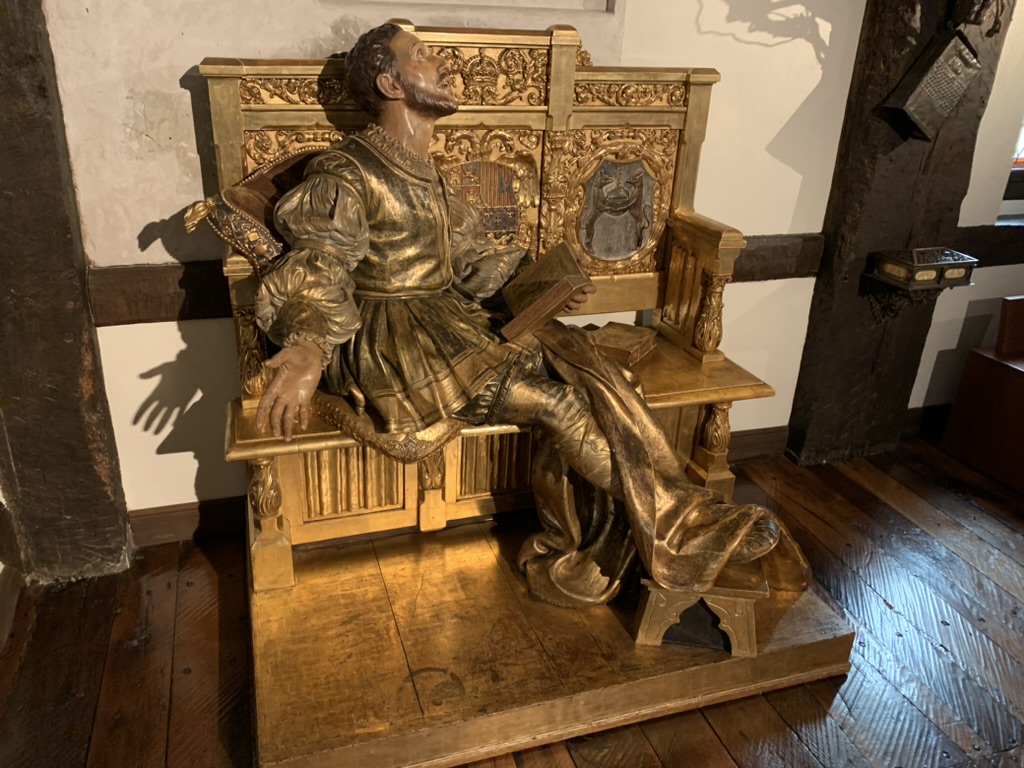
Ignatius was born in 1491 in a four-storey castle which still stands. This is where Ignatius returned to convalesce after he had his right leg shattered by a cannonball in 1521. The thirty-year-old Íñigo López de Loyola led the Spanish forces defending the castle of Pamplona against a significantly stronger French army. Combat lasted until a cannon-ball struck Íñigo shattering his right leg below the knee and wounding his left leg. On May 21, 1521 the garrison surrendered.

The castle of the Loyola family

Íñigo spent months convalescing at the family castle at Loyola. As a result of his injury, he would limp for the rest of his life. His brief military career was over.

As so often happens in times of personal tragedy, the crisis opened him to God. He began a journey from a courtly style of life into the less worldly lifestyle of penitent and pilgrim.

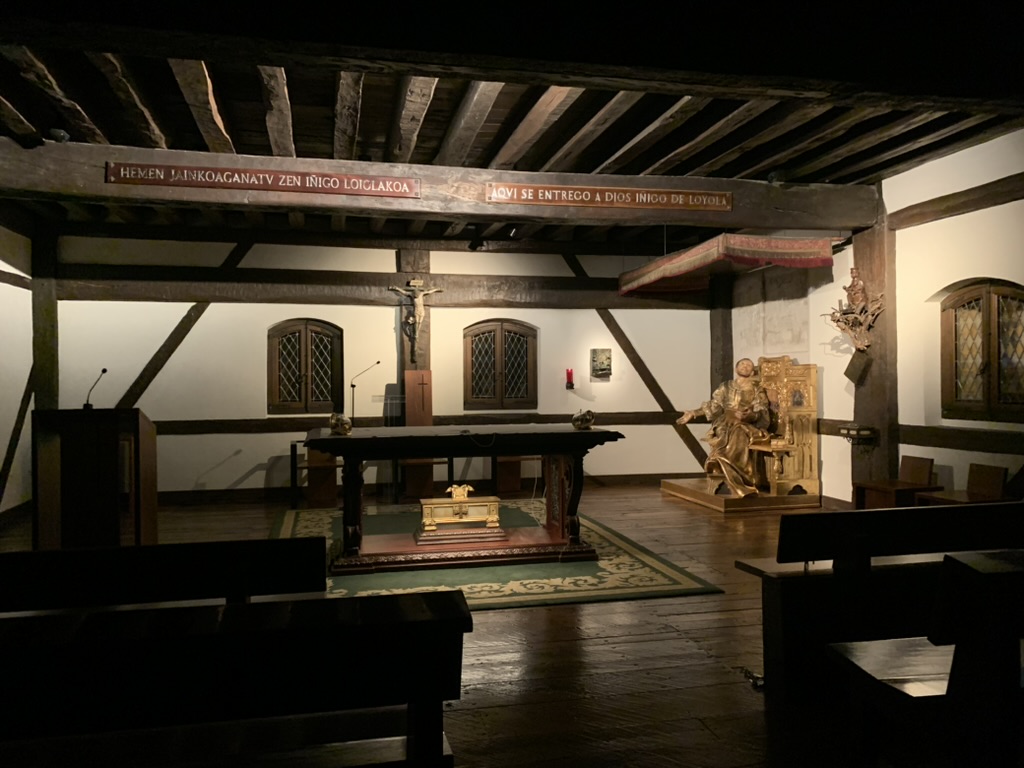
The room in which Ignatius recuperated from his shattered leg. It is now a chapel.

On his sickbed, Íñigo (who later took the name Ignatius) spent hours reading tales of chivalry, and day-dreaming about a noble woman and winning her hand.   Weary of day-dreaming, he asked for something religious to read. He was given The Life of Christ by Ludolph of Saxony, and a book about the lives of the saints called the Flowers of the Saints, both in Spanish.. An inveterate day-dreamer, he started to imagine himself being like these holy and daring people.

Ignatius Holy Day-Dreaming

In his Autobiography Ignatius describes how he slowly began to conceive of serving God like Saint Francis and Saint Dominic had. His first steps along this new life path were to embark on a pilgrimage to Jerusalem. So it could not be more fitting that our pilgrimage begins in this room just like his did.

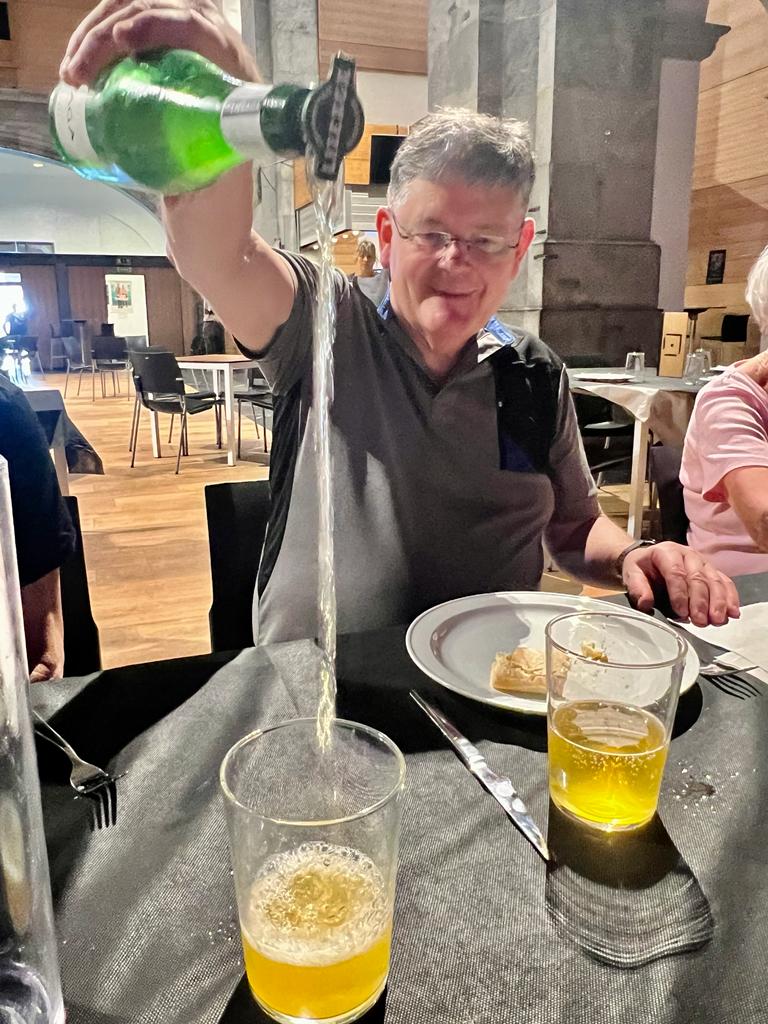
I tried my hand at pouring cider

Acquiring Wisdom: Ego Integrity versus Despair

AS MOST OF US ON THIS IGNATIAN CAMINO ARE OVER THE AGE OF 65, we are at the eighth of Erik Erikson’s stages of psychosocial development—ego integrity versus despair. This stage is associated with aging and approaching death. The task of this stage, which occurs in Late Adulthood (from age 65 until death), is to gather up the wisdom learned from earlier psychosocial stages of life and apply that wisdom in the world. Failure to master the eighth stage results in a failure to acquire wisdom. Erikson proposed that such failure would result in the opposite of wisdom which he saw as disdain—a contempt for life, one’s own or anyone else’s.

Wisdom or disdain?

Wisdom is the ego strength that results from the resolution of the dilemma of ego integrity versus despair. At this stage, a person looks back at his or her life. Integrity comes from an overall acceptance of his or her life and achievements. Inevitably there will be some episodes of his or her life story that will elicit pain and shame when remembered, and others that will elicit joy and fulfillment. The task a man or woman faces at this stage is to accept and rejoice in the good decisions taken and the love shown during life, and to be reconciled to any bad choices and failures to love. A man or woman who is basically satisfied with his or her life will be ready to face death.

Erikson states that integrity and wisdom are the result of, “…the acceptance of one’s own and only life cycle and of the people who have become significant to it… free of the wish that they should have been different, and an acceptance of the fact that one’s life is one’s own responsibility.”[1]

Despair

According to Erikson, despair results from dissatisfaction with one’s life as one considers aging and approaching death. A person may realise that he or she is not able to “start over” at this stage in life. A person may feel as though he or she has “run out of time” to complete the milestones of previous stages of development. This anxiety reflects both the fear of dying and the fear of not achieving life’s goals:

Despair expresses the feeling that time is short, too short for the attempt to start a new life and to try out alternate roads to integrity. Such a despair is often hidden behind a show of disgust, a misanthropy, or a chronic contemptuous displeasure with particular institutions and particular people.[2]

Despair is suffering without meaning

Since suffering is an inevitable part of life, one must try to find meaning in it. Psychiatrist Viktor Frankl writes, “despair is suffering without meaning.”[3]  According to Frankl, “Life can be made meaningful … through the stand we take toward a fate we no longer can change (an incurable disease, an inoperable cancer, or the like).”[4] Since human beings have free will, they can choose to find meaning in their suffering. What makes the difference between despair and meaning? Frankl answers: The “attitude we choose toward suffering.”[5] He explains:

Caught in a hopeless situation as its helpless victim, facing a fate that cannot be changed, a person still may turn his or her predicament into an achievement and accomplishment at the human level. He or she thus may bear witness to the human potential at its best, which is to turn tragedy into triumph.[6]

Frankl, a Holocaust survivor, recalls the negative and positive responses of prisoners to suffering in the Nazi concentration camps. He says that a person “may remain brave, dignified and unselfish. Or, in the bitter fight for self-preservation, he or she may forget human dignity and become no more than an animal.”[7] When a person’s situation or circumstance changes for the worse, then his or her attitude must change for the better in order to accept it. The kind of person that one becomes in suffering is the result of “an inner decision,” not the result of the suffering alone. To paraphrase Frankl: What kind of attitude will I have toward my suffering? Will I become bitter or better by it?

A study ranking traumatic events in old age lists first, death of a spouse, then being put in an institution, the death of a close relative, major personal injury or disease, and finally losing a job and divorce. Erikson expands on this list and describes how the elderly can experience diminishment in each of life’s eight stages. “Old patients seem to be mourning not only for time forfeited and space depleted but also… for autonomy weakened, initiative lost, intimacy missed, generativity neglected—not to speak of identity potentials bypassed or, indeed, an all too limiting identity lived.”

He sees the reminiscing so characteristic of later years as a looking backward which is set in motion by looking forward to death. It is as if nature equips us to integrate life by remembering experiences to garner wisdom rather than despair. The elderly person also instinctively knows the wisdom of beginning with positive memories of “the good old days,” because negative memories without love’s positive foundation can lead to despair, the trap of this stage of life.


[1] Erik Erikson, Identity and the Life Cycle, W. W. Norton & Company, 1994, 98.

[2] Erik Erikson, Growth and Crises of the Healthy Personality, 1950.

[3] Viktor Frankl, The Unconscious God, New York: Washington Square Press, 1985, p. 137.

[4] Viktor Frankl, Psychotherapy and Existentialism, New York: Simon and Schuster, 1967.

[5] Ibid, p. 24.

[6] Viktor Frankl, The Unconscious God, pp. 125-126.

[7] Viktor Frankl, Man’s Search for Meaning, New York: Pocket Books, 1963, p. 107.

What are the elements of the Ignatian Camino?

The Loyola Sanctuary

FIVE ELEMENTS are fundamental to the Ignatian Camino: (1) Silent Prayer, (2) Celebration of the Eucharist, (3) Encountering Challenges, (4) Sharing in the Pilgrim Circle, and (5) Individual Examen. During “Walking with Inigo: The Ignatian Camino” these five elements will be present:

  1. Silent Prayer

Each morning, before we commence our walk, there will be a 5-minute introduction to the theme of the day followed by two hours of silent meditation as we walk. After lunch, we will have another hour of silent prayer as we walk.

2. Celebration of the Eucharist

We will either attend Mass in a local church or celebrate the Eucharist at the place where we are staying.

3. Encountering challenges

Pilgrimage challenges us in unexpected ways and can lead us to learn much about ourselves. The challenge can come from various directions: it might be that the walking puts me in new situations, it might be the people we meet, cultural differences, relationship with my companions, living conditions, being far from home, or just weariness. What comes up for me during my walking—memories, regrets, suffering—will also challenge me.

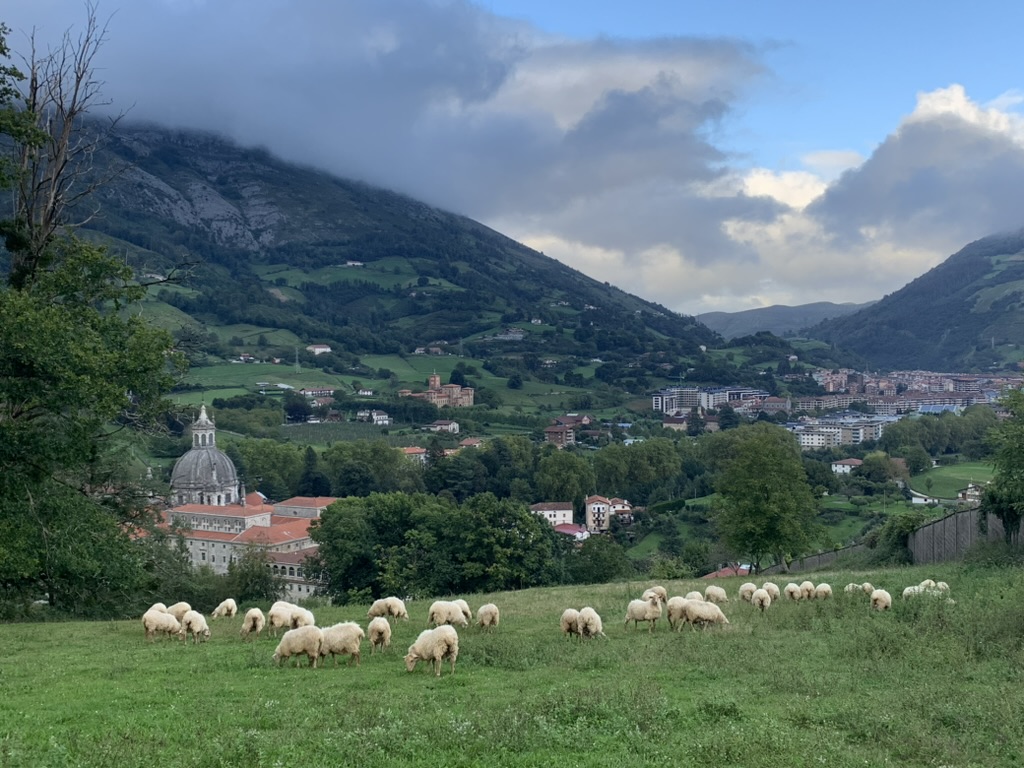
The Loyola Sanctuary from the base of Monte Izarraitz

4. Sharing in the Pilgrim Circle

The Pilgrim Circle is a central element of the Ignatian Camino. It gives pilgrims the chance to reflect on the day lived together, and to recount some of their personal experiences. The Pilgrim Circle is not a matter of discussing or responding to whatever each one says. Rather, we make room for one another, listening with respect and learning from each other’s experiences and insights. The Pilgrim Circle takes place in groups of 7 or 8 people. Ideally, the Pilgrim Circle should last between 30 and 45 minutes. It is led by the spiritual director or by one of the pilgrims, and has these steps:

A) A brief reflection. Each person takes a moment to look over the day, or days, just past.

B) The first two rounds are for listening only. As each person speaks the others listen; what the person says is not discussed — unless, if necessary, to ask for clarification.

Round 1

  • How has the day gone for me?
  • When did I feel joy?
  • When did I find things hard?

Round 2

  • How were the day’s themes and the texts read in the morning reflected over the course of the day?

C) In the third round there can be more discussion about what has been said. However, it’s not about imposing a point of view or convincing others of a particular opinion. The object is to share experiences and learn from one another.

Round 3

  • What especially struck me from what someone has said?
  • Is there anything else I’d like to share in the light of what I’ve heard?

D) Rapid last round. Conclusion. Each one responds to the last question with one word or short phrase:

  • What is my feeling at the end of this Pilgrim Circle?

5. An Individual Examen of the Day

Ignatius considered the Examen of the day a prayer of great importance, so much so that he wrote that if a Jesuit finds himself short of time to pray, at least he should not omit his Examen. Why? Because God can be found in our daily lives. 

If you think about it, each day is filled with impressions, encounters, and experiences. We go through happiness and disappointment; we feel sadness, desire, enthusiasm, and many other things besides. We mustn’t make too rapid a judgment on what we experience: God sometimes speaks to us in what energizes us, at other times God does so in what upsets us, and wants to lead us by means of all these experiences. If we allow ourselves to listen to the voice of God with us, we will be able every day to grow a little freer, more patient and more filled with love.

The Ignatian Examen can be made anywhere: on the beach, in a car, at home, in the library. It takes some 10 or 15 minutes and consists of five very simple steps, which can be set out in various ways. Here is one way:

  1. I begin with some sign or gesture, such as bowing the head or making the sign of the cross. I thus recall God’s presence — even if at that moment I don’t feel it.
  2. I ask the Spirit for light and assistance, to aid me as I look at the day just past.
  3. I review the day, placing it before God. One by one, I allow the events I have lived through to emerge into view. If it helps, I can ask myself:
    • What am I most grateful for in my day? Why?
    • What am I least grateful for in my day? Why?
    • What do I think God was trying to say to me in these moments?
  4. I thank God for the day I have lived through. I ask pardon for anything that has led me away from him. I ask for God’s help and grace in whatever I may feel I need at this moment.
  5. I look forward to tomorrow. I place it in God’s hands. I end by praying the Our Father or another prayer, finishing with the same gesture I began with.

How to be open to God on the Ignatian Camino (and in life…)

Here are a few suggestions to help you open yourself to God on the Ignatian Camino:

1.    Enter into the silence of the Camino

Isaac of Nineveh (613-700 AD):

“Many are continually seeking, but they alone find who remain in silence. Everyone who delights in a multitude of words, even though they say admirable things, is empty within. If you love truth, be a lover of silence. Silence like the sunlight will illuminate you in God. Silence will unite you to God. More than all things love silence; it brings you a fruit that tongue cannot describe. In the beginning, we have to force ourselves to be silent. But then there is something born that draws us to silence. May God give you an experience of the ‘something’ that is born of silence. If only you practice this, untold light will dawn on you in consequence. After a while a certain sweetness is born in the heart of this exercise and the body is drawn almost by force to remain in silence.”

Ammonas of Egypt (4th Century):

“I have shown you the power of silence, how thoroughly it heals and how fully pleasing it is to God. It is by silence that the power and the mystery of God will become known to you.”

2.    Invest time in prayer

As you walk, give as much time as you can to hours of relating to God. If you invest much time, your prayer will deepen considerably and this will be a lasting treasure you take from this Camino.

3.    Desire God

If you wish to attain a deeper experience of God on this Camino, desire God. God desires that you desire him. If you want to deeply desire God, ask God for the desire, beg God for it.

4.    Courage and generosity

The Idea of Pilgrimage in the Experience of Ignatius Loyola[1]

THE IDEA OF PILGRIMAGE occupied an important place in the life and thought of Ignatius of Loyola. In the autobiography he dictated to Gonçalves da Câmara late in his life, he refers to himself as “the pilgrim”. He went on a pilgrimage from Loyola to Jerusalem, and he describes in detail his long and difficult journey.

The term pilgrimage can be used in different senses. The literal meaning — a journey to a shrine or sacred place as an act of religious devotion — describes a very old and common religious practice, one which has been part of Christian devotion since early times.  The term can also have an allegorical meaning. Life can be viewed as a pilgrimage, that is, as a journey fraught with obstacles and difficulties through this world to the world beyond.

In addition to these meanings of the term, there is another understanding of pilgrimage: the spiritual sense of the term. A pilgrimage can be an interior journey toward some goal or ideal. It can involve finding the meaning of, or mission for, one’s life, and it may bring about inner growth or transformation. An external pilgrimage may symbolize or in some way facilitate a person’s inner search. These various understandings of pilgrimage tend to merge at a deeper level. The reason perhaps is that they are all rooted in the concept of the person as traveler, en route toward some destination, towards some end.

The geographical pilgrimage is the symbolic acting out of an inner journey. The inner journey is the interpolation of the meanings and signs of the outer pilgrimage. One can have one without the other. It is best to have both.”

Thomas Merton

Judging from his autobiography, Ignatius of Loyola was acutely aware of his condition as a traveler. This awareness had its origins in his conversion and in the pilgrimage he made to the Holy Land. But Ignatius’ continuing reference to himself as “the pilgrim” throughout his story and his use of the term itself after so many years had gone by suggest a meaning beyond the purely literal one.

Ignatius’ conversion from the very start was linked to the idea of a Jerusalem pilgrimage. He set out from Loyola on his pilgrim journey in early 1522 and went first to the shrine of Our Lady of Montserrat in Catalonia, as we will, then to the nearby town of Manresa where he remained for a year. Though an interruption of the Jerusalem trip, his experiences at Manresa were of important in his spiritual development. He informs us that God instructed him like a schoolmaster, that his mind was enlightened, and his understanding deepened. Here Inigo began to compose the Spiritual Exercises.


[1] These notes are taken from John C. Olin’s article “The Idea of Pilgrimage in the Experience of Ignatius Loyola.” Church History, 1979, Vol. 48, No. 4.