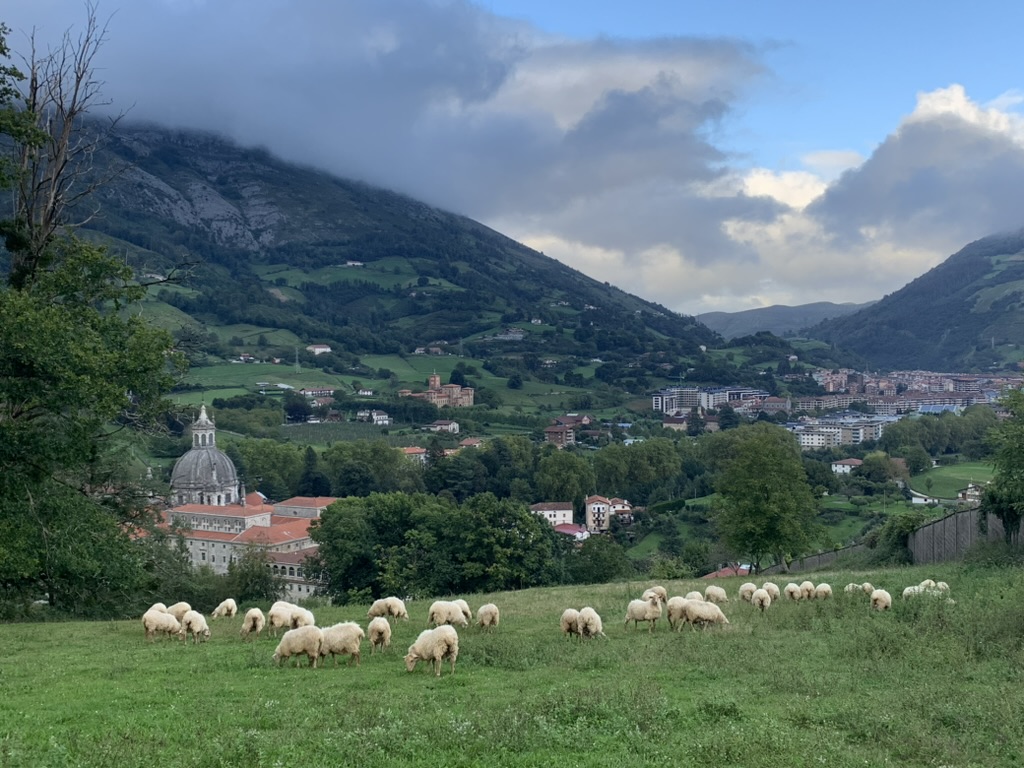
FIVE ELEMENTS are fundamental to the Ignatian Camino: (1) Silent Prayer, (2) Celebration of the Eucharist, (3) Encountering Challenges, (4) Sharing in the Pilgrim Circle, and (5) Individual Examen. During “Walking with Inigo: The Ignatian Camino” these five elements will be present:
- Silent Prayer
Each morning, before we commence our walk, there will be a 5-minute introduction to the theme of the day followed by two hours of silent meditation as we walk. After lunch, we will have another hour of silent prayer as we walk.
2. Celebration of the Eucharist
We will either attend Mass in a local church or celebrate the Eucharist at the place where we are staying.
3. Encountering challenges
Pilgrimage challenges us in unexpected ways and can lead us to learn much about ourselves. The challenge can come from various directions: it might be that the walking puts me in new situations, it might be the people we meet, cultural differences, relationship with my companions, living conditions, being far from home, or just weariness. What comes up for me during my walking—memories, regrets, suffering—will also challenge me.

4. Sharing in the Pilgrim Circle
The Pilgrim Circle is a central element of the Ignatian Camino. It gives pilgrims the chance to reflect on the day lived together, and to recount some of their personal experiences. The Pilgrim Circle is not a matter of discussing or responding to whatever each one says. Rather, we make room for one another, listening with respect and learning from each other’s experiences and insights. The Pilgrim Circle takes place in groups of 7 or 8 people. Ideally, the Pilgrim Circle should last between 30 and 45 minutes. It is led by the spiritual director or by one of the pilgrims, and has these steps:
A) A brief reflection. Each person takes a moment to look over the day, or days, just past.
B) The first two rounds are for listening only. As each person speaks the others listen; what the person says is not discussed — unless, if necessary, to ask for clarification.
Round 1
- How has the day gone for me?
- When did I feel joy?
- When did I find things hard?
Round 2
- How were the day’s themes and the texts read in the morning reflected over the course of the day?
C) In the third round there can be more discussion about what has been said. However, it’s not about imposing a point of view or convincing others of a particular opinion. The object is to share experiences and learn from one another.
Round 3
- What especially struck me from what someone has said?
- Is there anything else I’d like to share in the light of what I’ve heard?
D) Rapid last round. Conclusion. Each one responds to the last question with one word or short phrase:
- What is my feeling at the end of this Pilgrim Circle?
5. An Individual Examen of the Day
Ignatius considered the Examen of the day a prayer of great importance, so much so that he wrote that if a Jesuit finds himself short of time to pray, at least he should not omit his Examen. Why? Because God can be found in our daily lives.
If you think about it, each day is filled with impressions, encounters, and experiences. We go through happiness and disappointment; we feel sadness, desire, enthusiasm, and many other things besides. We mustn’t make too rapid a judgment on what we experience: God sometimes speaks to us in what energizes us, at other times God does so in what upsets us, and wants to lead us by means of all these experiences. If we allow ourselves to listen to the voice of God with us, we will be able every day to grow a little freer, more patient and more filled with love.
The Ignatian Examen can be made anywhere: on the beach, in a car, at home, in the library. It takes some 10 or 15 minutes and consists of five very simple steps, which can be set out in various ways. Here is one way:
- I begin with some sign or gesture, such as bowing the head or making the sign of the cross. I thus recall God’s presence — even if at that moment I don’t feel it.
- I ask the Spirit for light and assistance, to aid me as I look at the day just past.
- I review the day, placing it before God. One by one, I allow the events I have lived through to emerge into view. If it helps, I can ask myself:
- What am I most grateful for in my day? Why?
- What am I least grateful for in my day? Why?
- What do I think God was trying to say to me in these moments?
- I thank God for the day I have lived through. I ask pardon for anything that has led me away from him. I ask for God’s help and grace in whatever I may feel I need at this moment.
- I look forward to tomorrow. I place it in God’s hands. I end by praying the Our Father or another prayer, finishing with the same gesture I began with.

 Walking with Inigo — The Ignatian Camino
Michael,
Thank you for these reflections on the daily structure. I will certainly miss the sharing that will happen in the Pilgrim’s Circles. Although part of my Examen of the Day now includes the medications I’m taking and the side effects, the more important reflection is how I found God in my life. Today it was the visit of a friend who rambled our property with me and showed how I could accentuate the natural beauty of the rock outcroppings, a task I began later in the day. I’m looking forward to tomorrow’s visit by another friend who will soon be walking with his wife the last 100 km of the Camino de Santiago. A regular reminder that God comes to us through our relationships with others.
Jim Gudaitis